I tested Sparky, Walmart's one-year-old AI agent, on the site and inside ChatGPT
Sep 2, 2026 · 6 min read
Gautier Tubert
CMO @ Agentic Commerce Club
Hello! Good to meet you, I'm Gautier, CMO at Dialog, and this is the first issue of the Agentic Commerce Club. 👋
Everyone talks about what is happening in the US around agentic commerce. So this week, with a VPN and an American phone number, I went and tested Sparky, Walmart's agent.
I. On site: logging in is mandatory
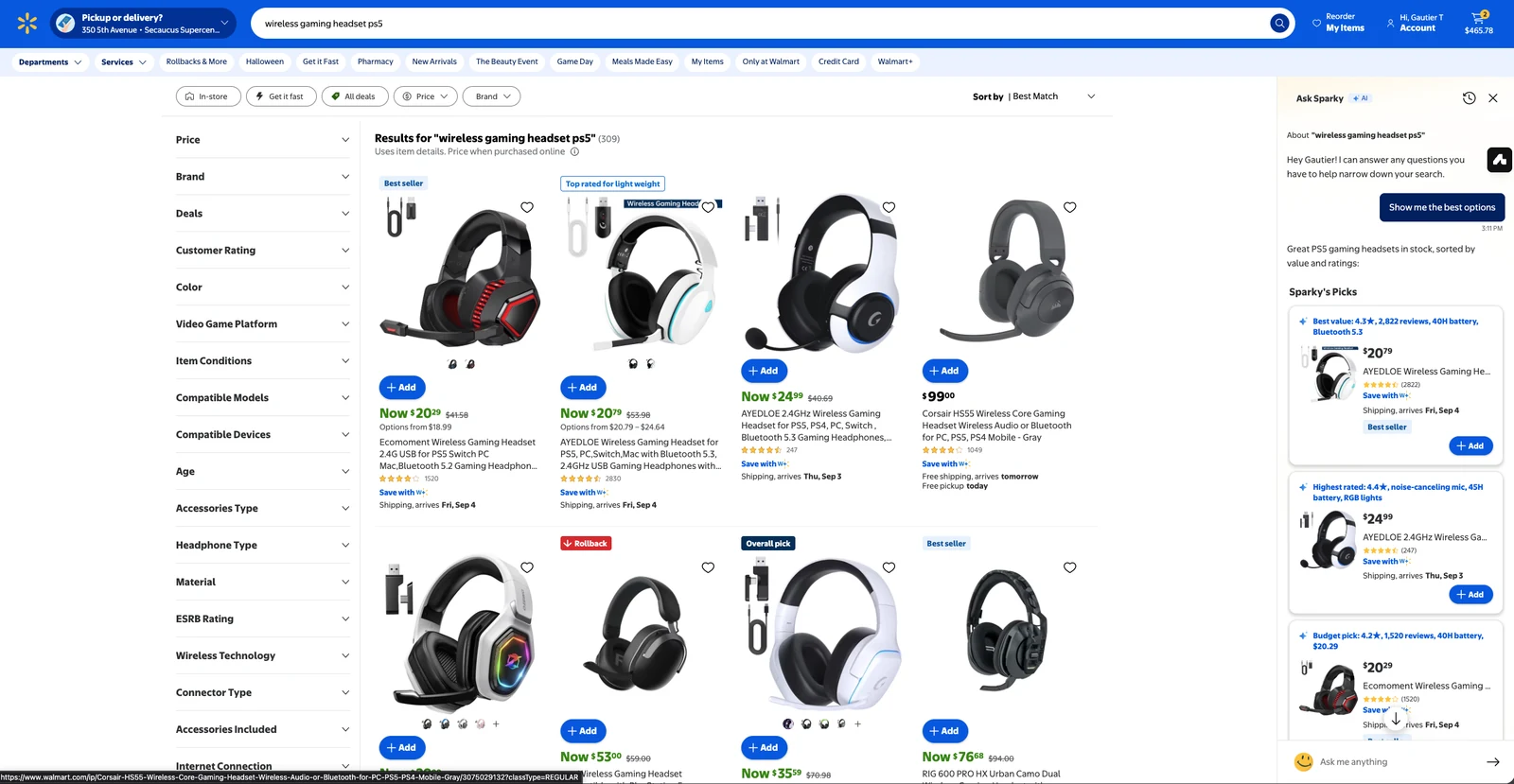
On the site, Sparky lives in two fairly classic places: the product page, and a bubble in the bottom right corner of every page, recognisable by its smiley logo.
What surprised me most while testing Sparky: you cannot talk to it without being logged in.
On walmart.com, Sparky asks you to log in before the first message.
There is no separate account to create: Sparky goes through your usual Walmart account, the one you already order with. And the login has been there since day one, it is not a late addition.
It is not alone. Amazon retired Rufus on 13 May 2026 and replaced it with Alexa for Shopping, where logging in is mandatory too, with access to your profile and your history.
Four possible reasons
The toll gate: without an account, the assistant becomes a free API anyone can call in a loop.
Agentic commerce: to buy on your behalf, the agent needs an address, a payment method, and to know who it is acting for.
The legal side: who authorised what, who pays in case of fraud, none of it is settled without an account.
Advertising: targeting and attribution only work on logged-in traffic.
II. What it does
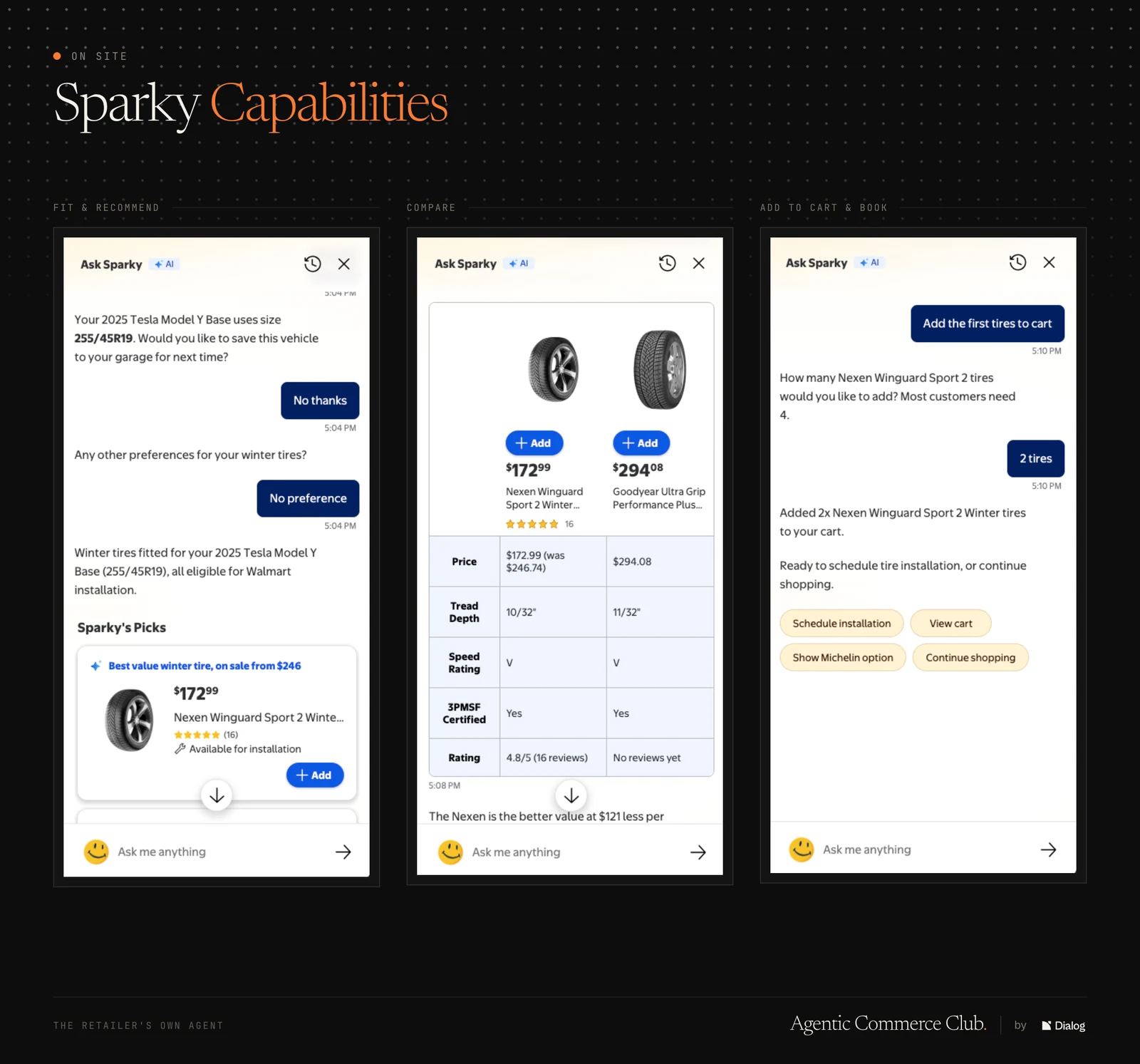
The main function is still product search: surfacing a handful of relevant references out of millions.
Let me give you examples of the products that come up most with Sparky. Phone chargers: easier to do in a conversational experience than in a search bar. We also sell a lot of tyres.
Daniel Danker, Executive Vice President, AI Acceleration, Product & Design, Walmart
The rest follows directly from the logged-in account. Sparky sees what you have ordered before and finds your usual items instantly. It knows your store and your preferred fulfilment method (pickup, home delivery, shipping) and adapts to it.
It also compares products side by side: specs, prices and reviews. Finally, it acts on the cart: adding, removing, changing quantities.
I compared Sparky's results with those of classic search: they recommend the same thing.
III. Sparky inside ChatGPT
The context, in two dates.
November 2025: Walmart plugs 200,000 products into Instant Checkout, the payment system OpenAI launched in September, where the transaction happens directly inside ChatGPT. The result: three times less conversion than a plain click through to walmart.com, even though ChatGPT was bringing twice as many new customers as classic search.
March 2026: OpenAI backs off and hands checkout back to merchants. Walmart takes the opportunity to plug Sparky into ChatGPT instead: same account, same cart, same payment as on the site.
I installed the ChatGPT app. As on the site, logging in is mandatory before you can even type the first prompt.
Inside ChatGPT too, the Walmart login comes before the first prompt.
The experience then looks like the other retail apps: on a query, an interface in Walmart's colours appears with the products and the choice of variants.
You add to cart and pay without leaving the conversation, address already filled in.
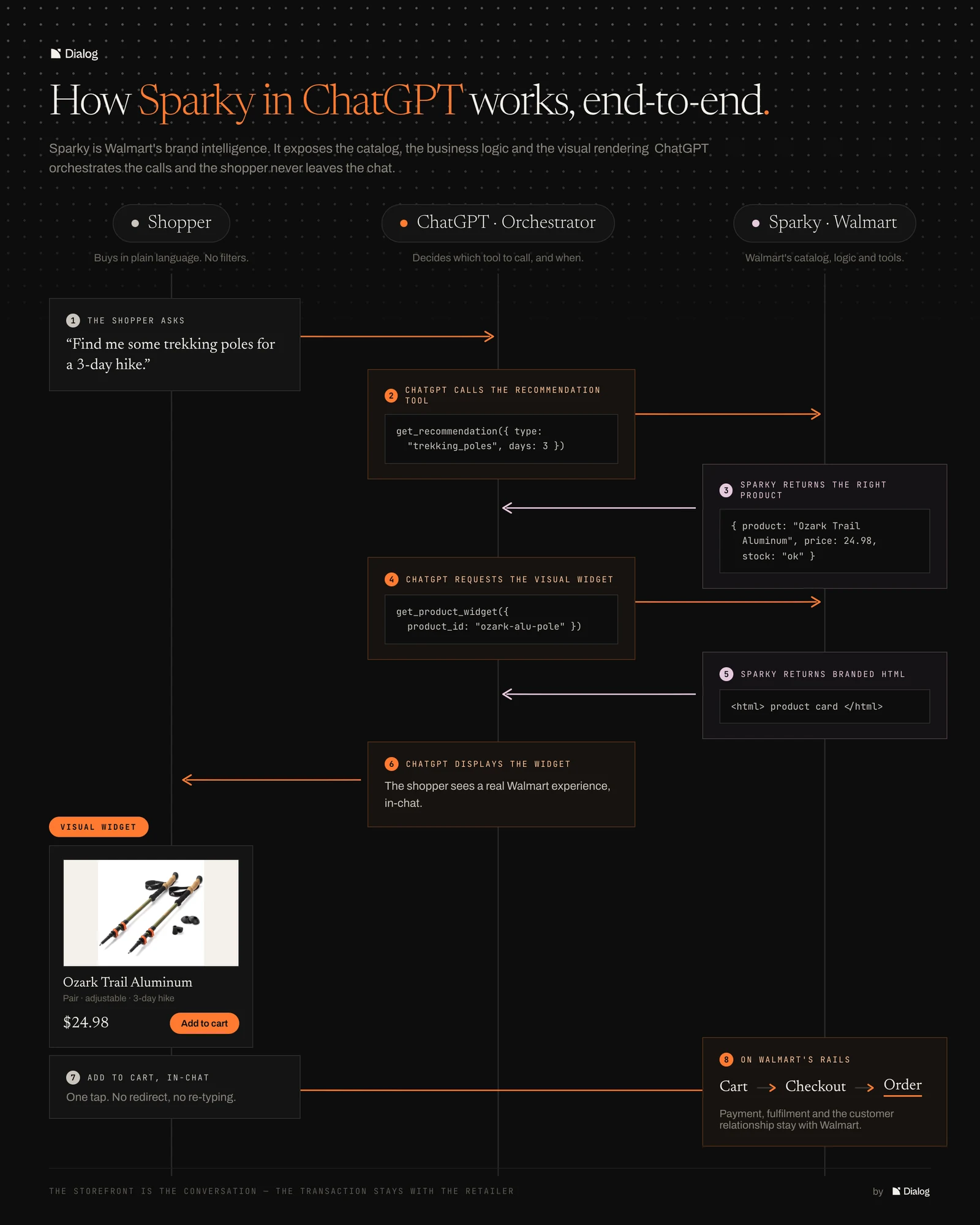
Sparky's smiley never appears. You keep talking to ChatGPT from start to finish. I dug into what is really meant by “Sparky inside ChatGPT”, and here is the answer.
You phrase your request in natural language, ChatGPT decides which tools to call, and Sparky answers: which products to recommend, at what price, in stock or not, then the Walmart-branded display that slots into the conversation. When you add to cart, everything goes back onto Walmart's rails: cart, payment, delivery and customer care stay with the merchant.
In other words, the storefront becomes the conversation, but the transaction never leaves the retailer.
And that is only the visible part
Sparky is the agent customers see, but Walmart is building three more internally:
an associate agent for its employees (schedules, sales data);
Marty for its suppliers, sellers and advertisers (onboarding, orders, campaigns);
a developer agent for its tech teams.
All announced, none publicly measured to date. What is happening at Walmart goes well beyond the shopping assistant: the whole company is reorganising around agents.
Thank you for reading this first issue. If you have feedback on it, I would love to read it.
See you very soon, Gautier CMO @ Agentic Commerce Club