


Article overview
Dialog is our pick when shoppers can't work out what to buy. It's built for pre-purchase discovery, and at $399/mo for 50,000 visitors the bill is knowable before you sign.
Gorgias is the pick when the problem is inbound questions. It's the Shopify helpdesk default at 25,452 stores, with a shopping assistant added in 2025.
Attentive is the pick when the problem is bringing people back. Brand-initiated SMS at scale, which is a different job from the two above.
Introduction
Conversational commerce is one of those phrases that sounds like it means something until you try to buy one.
Search for a conversational commerce platform and you'll get a helpdesk, an SMS marketing tool, a customer data platform and an AI shopping assistant, all using the same three words to describe four unrelated products.
That vagueness had a reason. For most of the last decade, conversational commerce meant a chatbot, and chatbots were mostly bad. They matched keywords, followed decision trees, and dead-ended the moment a shopper asked something the script didn't anticipate. Calling that "commerce" was generous.
LLMs changed the ceiling. An assistant can now read a catalog, understand what someone means rather than what they typed, and hold a conversation that goes somewhere. That's a genuinely different product, and it deserves a clearer name than the one the category inherited.
So this piece does the boring part first. What conversational commerce actually means, the different types split by the job they do, real examples, and how to choose. Then, and only then, four platform recommendations, one per use case.
The four platforms at a glance
One line before you read this table. These prices are not entry prices.
They're what a specific brand pays: a Shopify store with 50,000 monthly visitors, around 1,000 support tickets a month, sending roughly 20,000 SMS. We picked one scenario and priced everyone against it, because that's the only way to compare tools that bill on completely different units.
Platform | Use case | Cost at 50k visitors / 1k tickets / 20k SMS | G2 rating |
|---|---|---|---|
Dialog | Discovery and guided selling | $399/mo. Standard plan, covers up to 50k unique visitors. No add-ons, no seat minimum. | 5/5 (10 reviews) |
Gorgias | Conversational support | ≈$1,015/mo. Pro plan $550 (2,000 tickets, 190 AI interactions) + 310 extra AI interactions × $1.50 = $465 | 4.6/5 (562) |
Attentive | Outbound conversational marketing | ≈$1,050/mo. No public pricing; third-party sources indicate $100 platform fee + $0.01/SMS × 20,000 + $750 shortcode rental | 4.5/5 (1,483) |
InsiderOne | Enterprise engagement suite | No public pricing. Not self-serve, no free trial, and the shopping agent can't be bought on its own | 4.8/5 (1,395) |
Two honest notes on that table.
Dialog's 5/5 comes from 10 G2 reviews, against 562 for Gorgias and 1,395 for InsiderOne. AI shopping assistants are a category that barely existed three years ago, so every tool in it has a thin review history compared to a helpdesk founded in 2015 or a customer data platform founded in 2012. Read the small counts as "new category", not as "better product".
Attentive's figure is the softest number in the table. They don't publish pricing, so it comes from third-party sources rather than from Attentive.
What does conversational commerce mean?
Conversational commerce is selling through a conversation instead of through a form.
That's the whole idea. In a normal ecommerce flow, a shopper navigates a menu, applies filters, scans a grid, and decides alone. In conversational commerce they describe what they need in their own words, and something on the other end (an AI agent, a human, or both) interprets it and responds.
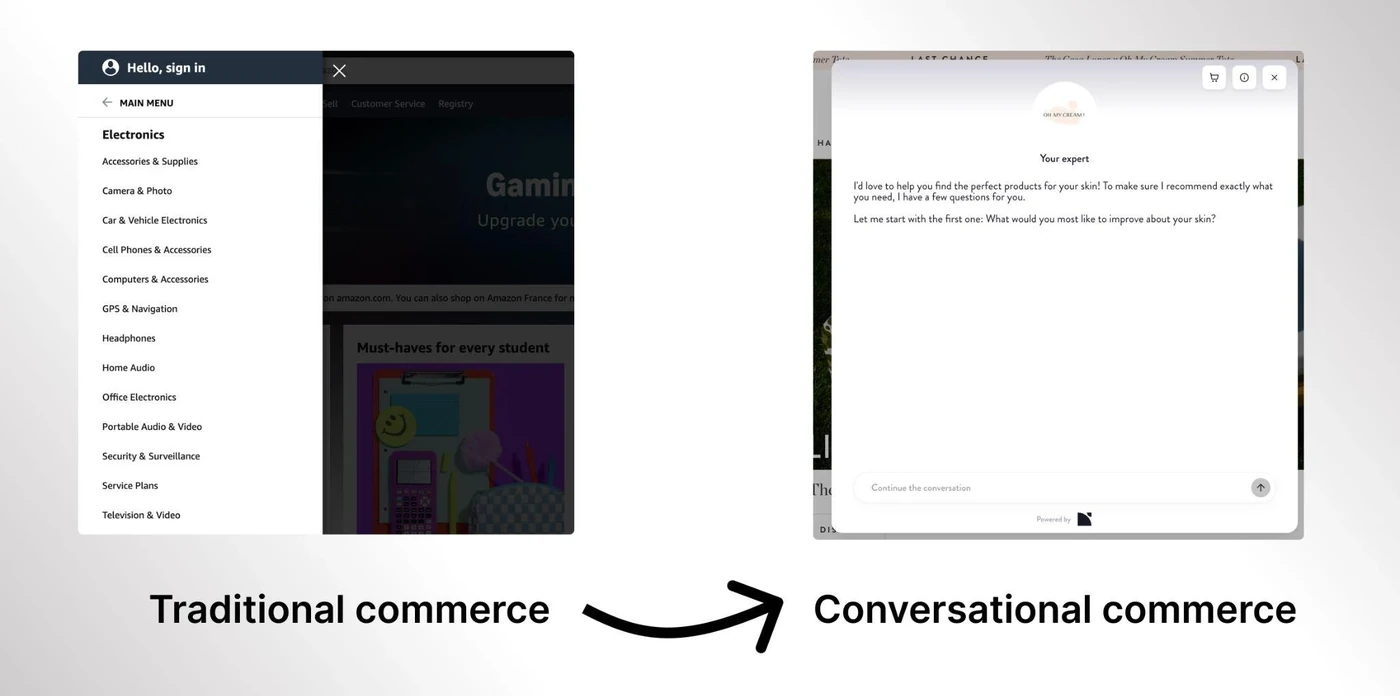
The term was coined by Chris Messina in 2015, and for years it mostly described chatbots in messaging apps. That framing has aged badly, because the channel turned out to be the least interesting part. What matters is whether the thing on the other end can actually help.
Here's the distinction that clears up most of the confusion: conversational commerce is not a channel, it's an interface. Chat, SMS, WhatsApp and voice are all channels. The category is defined by the shopper expressing intent in natural language, wherever that happens.
That's also why "conversational commerce platform" covers such different products. Once you define the category by the interface, four unrelated tools qualify.
The types of conversational commerce, by use case
Most articles on this topic split conversational commerce by channel: chatbots, messaging apps, voice assistants, SMS. That split is tidy and nearly useless when you're buying, because it tells you where the conversation happens and nothing about what it's for. Two tools in the "messaging app" bucket can be completely unrelated purchases.
Splitting by use case works better. Here are the five, and the answer on which ones LLMs actually changed.
Type | The job it does | Who starts it | Where it happens |
|---|---|---|---|
Discovery and guided selling | "Which one is right for me?" | Shopper | Your site |
Conversational support | "Where's my order? Can I return this?" | Shopper | Site, email, DMs |
Outbound conversational marketing | Bring them back | Brand | SMS, WhatsApp |
Enterprise engagement suites | All of the above, one vendor | Brand | Everywhere |
Agentic commerce | Buy inside an assistant that isn't yours | Shopper | ChatGPT, Gemini, Perplexity |
1. Discovery and guided selling
The shopper knows the problem but not the product. They want a running shoe for flat feet, a moisturiser for reactive skin, a suitcase that fits a specific airline's cabin rule. A filter menu can't answer any of those, because the question isn't about attributes, it's about fit.
This is where LLMs made the biggest difference, and it isn't close. A decision-tree quiz asks five fixed questions and maps the answers to a product. An LLM-based assistant asks what it needs to ask, skips what's irrelevant, and handles the follow-up question that used to break everything.
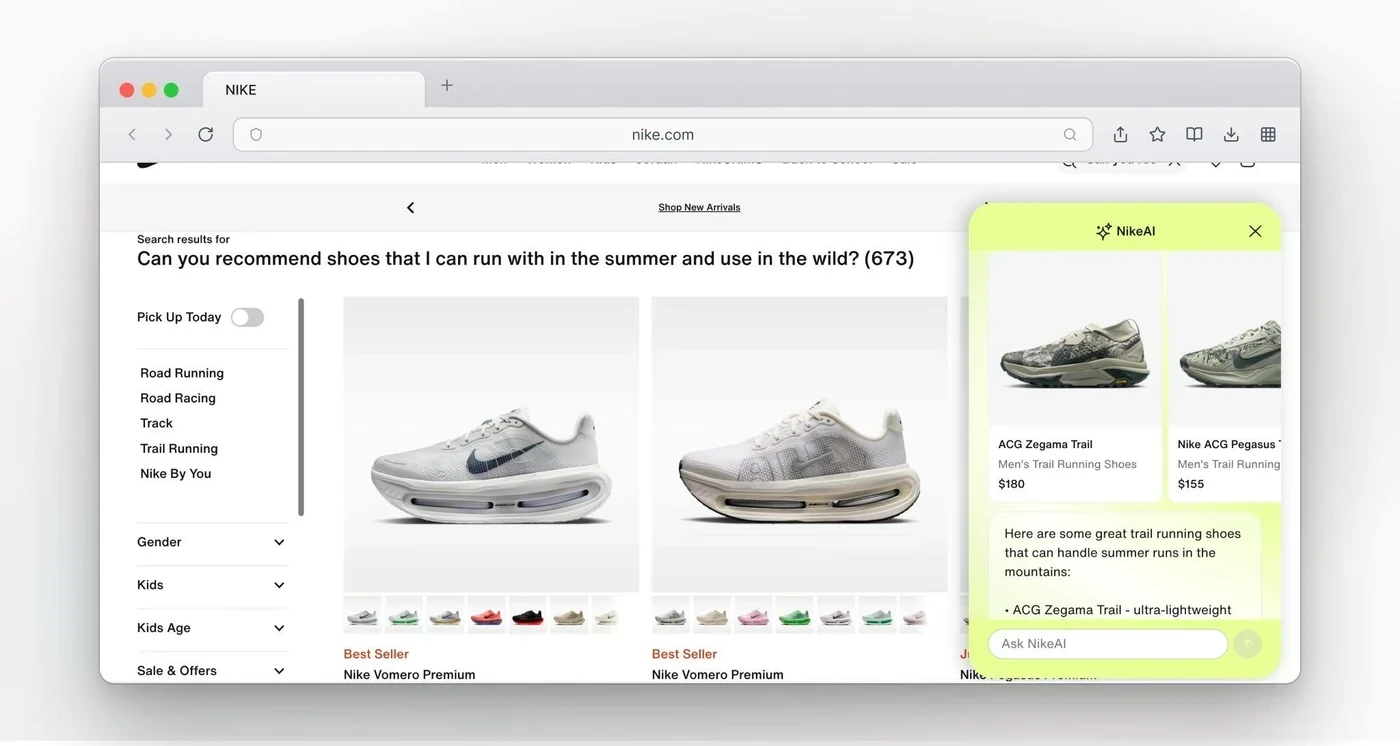
An AI shopping assistant on Nike.com
2. Conversational support
Order status, returns, sizing, "does this ship to Ireland". These questions have correct answers sitting in a database, and the work is retrieving them fast without a human.
LLMs improved this bucket meaningfully, mostly by widening the range of phrasings a bot can handle before it gives up. But the job itself is unchanged and pre-LLM tools already did it acceptably. This is an upgrade, not a new capability.
3. Outbound conversational marketing
The brand starts the conversation. Abandoned cart, back in stock, replenishment reminders, a promotion. The channel is SMS in the US, WhatsApp in most of Latin America, India and the Gulf.
Worth saying plainly: this is the bucket LLMs changed least, and it's where most conversational commerce budget goes. The messages are still mostly templates on a schedule. The "conversation" typically starts when a customer replies, and handling replies well is a recent bolt-on rather than the core product.
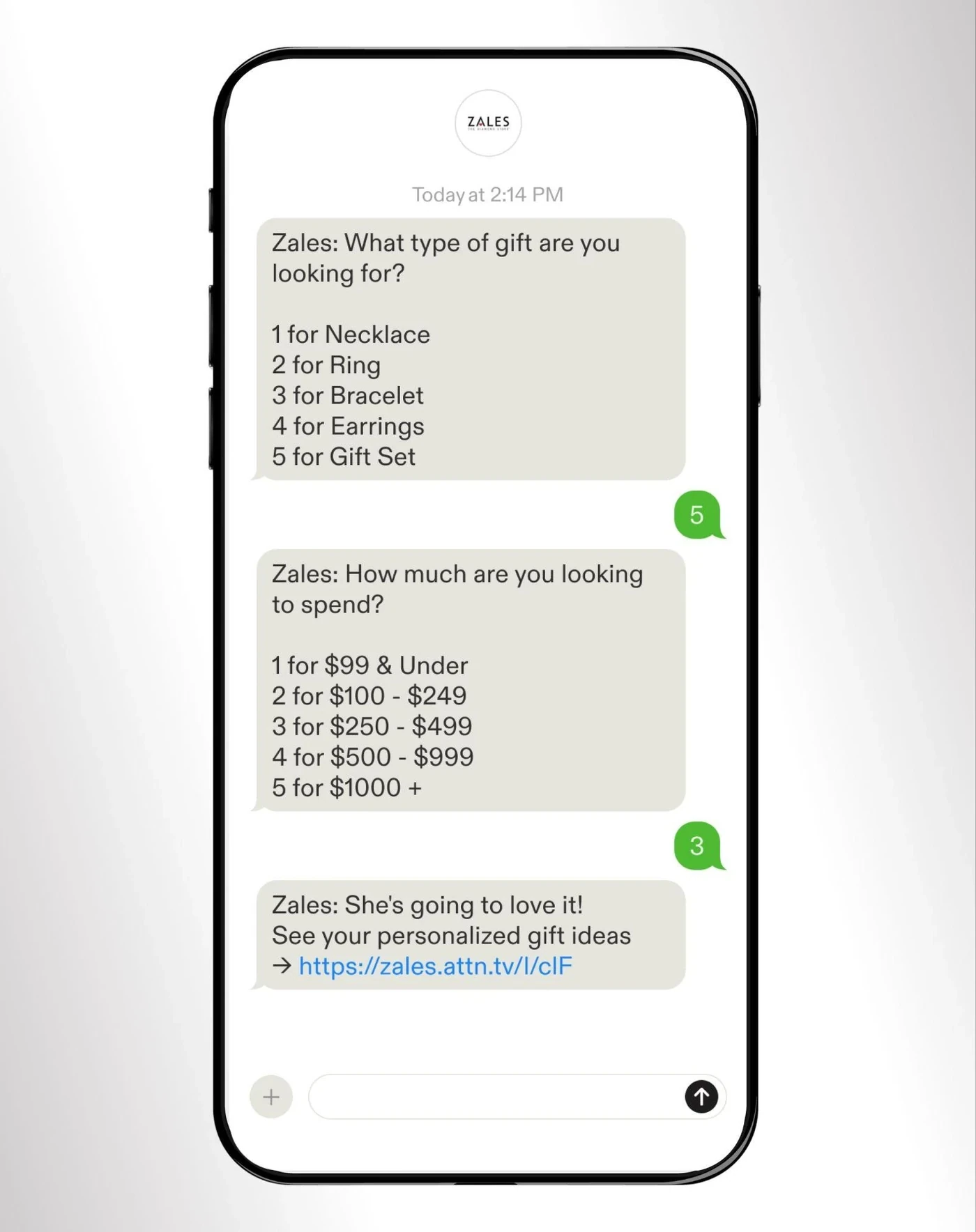
An SMS engagement campaign that triggers a 1-to-1 discussion between the shopper and the brand. Source: attentive.com
4. Enterprise engagement suites
One vendor for the customer data platform, the campaigns, the on-site personalization and now the AI agent. The pitch is consolidation: fewer contracts, one profile per customer, everything talking to everything.
This is a procurement decision more than a product decision. It makes sense at Toyota scale and very little sense below it.
5. Agentic commerce
The newest and the strangest. The shopper doesn't come to your site at all. They ask ChatGPT or Gemini for a recommendation, and the purchase happens inside that assistant.
We've given this its own section further down, because it isn't a product you can buy yet and pretending otherwise would be misleading.
Examples of conversational commerce
A cosmetics shopper uploads a photo of their skin. They get a routine recommendation built from the brand's actual catalog rather than a generic article. This is live in Dialog's Personal Shopper across cosmetics, home and fashion; for furniture the shopper photographs their living room, for fashion a style reference.
A shopper asks a product page a question at 11pm. "Will this fit a 15-inch laptop?" The assistant on the page answers from the spec sheet instead of leaving them to hunt through a description or wait until morning for support.
Someone replies to a marketing text. They got an SMS about a restock and answer with a question about sizing. Attentive's AI handles the reply, and escalates to a human in the Conversations Inbox when it can't.
A shopper asks ChatGPT which vacuum to buy. No brand site involved. This is the example that didn't exist two years ago and is currently the most disruptive one on the list.
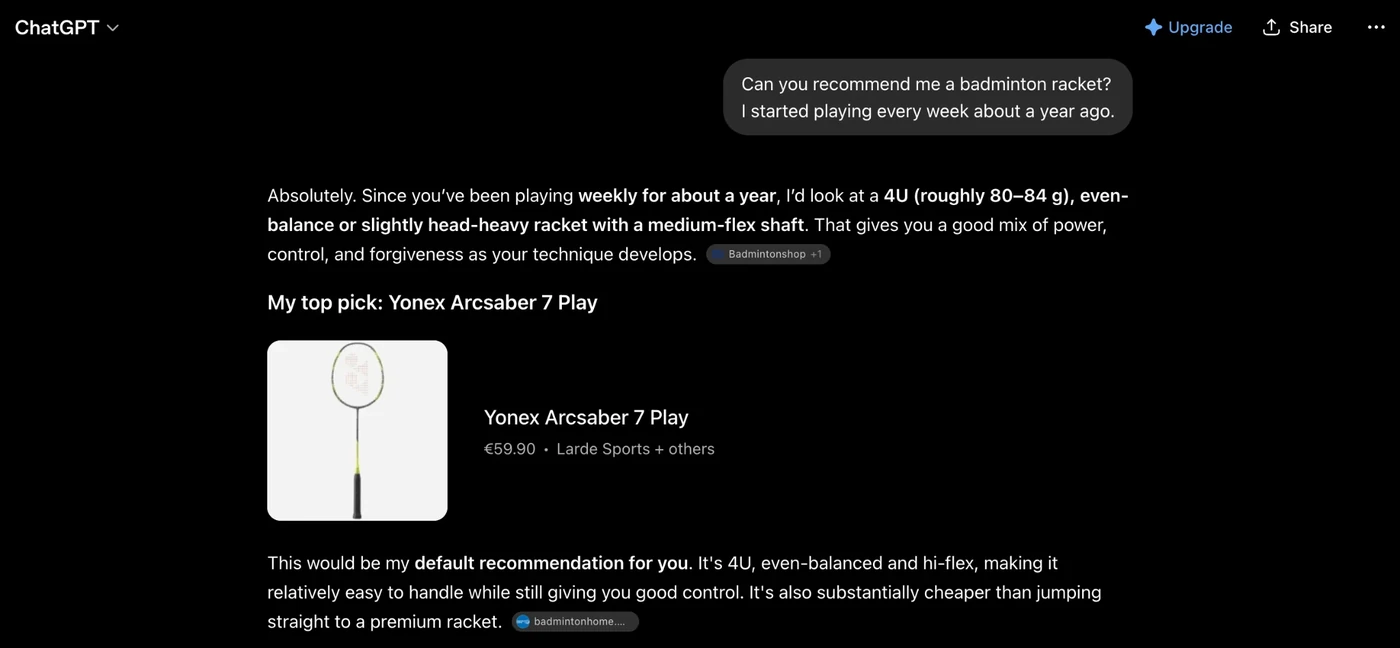
A shopper asking ChatGPT for a badminton racket
How to choose the right conversational commerce platform for your business
Four questions, in order. The first one does most of the work.
1. Which of the five jobs are you actually hiring for?
If you can't answer this, no comparison table will help you, because the products aren't substitutes. A helpdesk will not fix product discovery, and a discovery tool will not answer "where's my order". Brands regularly buy the wrong bucket and conclude the category doesn't work.
A blunt diagnostic: look at where you lose people. High traffic and low add-to-cart is a discovery problem. High ticket volume is a support problem. Healthy conversion and weak repeat purchase is an outbound problem.
2. What does it bill on, and can you predict that number?
This is the question the category hides, and the reason the summary table above is built the way it is.
Dialog bills on traffic. You know your traffic, so you know your bill.
Gorgias bills on tickets plus AI interactions, and neither tracks your traffic, which means your bill peaks exactly when your support load does, in November.
Attentive bills on messages sent plus a platform fee plus shortcode rental. InsiderOne doesn't say.
Take your own numbers and price each option, rather than comparing the headline plan prices. Those headline prices are close to meaningless here.
3. Can you try it before you talk to sales?
A real dividing line, and a decent proxy for who the product is built for. Dialog is self-serve on Shopify with a free tier. Gorgias has a 7-day trial and is self-serve. Attentive has a 30-day trial but no self-serve. InsiderOne has neither.
4. Will it still make sense in 18 months?
Ask any vendor how their agent behaves when your customer is talking to ChatGPT instead of your website. The answers will vary a lot, and they're informative.
The 4 conversational commerce platforms we recommend
One per use case. Each section ends with the alternatives worth a look in that same bucket.
Dialog: best for discovery and guided selling
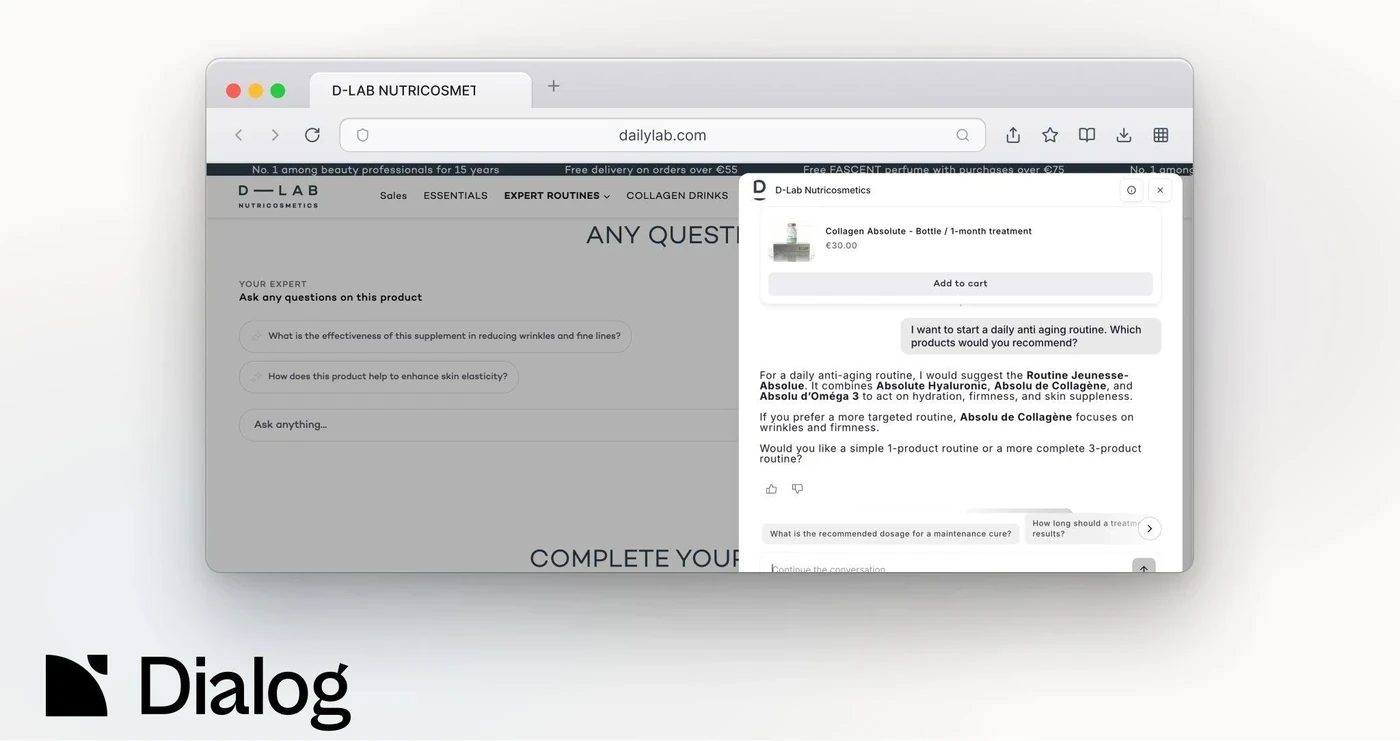
The verdict
If your problem is that shoppers land on your site and can't work out which product is right for them, this is the bucket you're shopping in, and Dialog is built for it rather than extended into it. It's the strongest fit for complex or high-consideration catalogs, and the pricing is the most predictable in this comparison because it tracks traffic. The honest caveat is the review base: 10 G2 reviews is thin, and if you need a long public track record before you sign, Gorgias and InsiderOne have one and Dialog doesn't yet.
Who it works best for
Mid-market and enterprise brands with 25,000+ monthly visitors on Shopify, or 100,000+ on other platforms. It's aimed squarely at catalogs where the customer needs to understand the product before buying: large ranges, premium pricing, technical specs. Current customers include OhMyCream, Delsey Paris, MG and Shiseido, which tells you the shape of the fit.
Top features
Smart Search. Search that reads intent rather than keywords, so it surfaces the right product when the shopper doesn't know the right word.
AI PDP Assistant. Sits on the product page and answers technical questions and objections where the decision is actually being made.
AI Shopping Assistant. A full conversational experience with its own entry point. A brand can run several at once (a gift finder, a general advisor, a skin diagnostic), each with a different goal.
Photo upload. The shopper photographs their skin, their living room, or a style reference, and gets recommendations from the catalog. Live across cosmetics, home and fashion.
Smart Reengagement. Captures email or phone with explicit opt-in after a session and reactivates hesitant shoppers based on what they asked and didn't buy.
Analytics and ROI. Native A/B testing with the conversion delta visible in GA4.
The Personal Shopper is worth separating from the quiz builders it gets compared to. A quiz is a fixed decision tree; the questions don't change and the conversation ends at the recommendation. Dialog's version adapts the wording, skips irrelevant questions, and lets the shopper keep talking afterwards. That last part is the difference between a lead capture form and a salesperson.
Integrations
Salesforce Commerce Cloud, Shopify, Scayle, Spryker, SAP and BigCommerce on the platform side. For reengagement it pushes to Klaviyo, Brevo, Braze, Salesforce Marketing Cloud and HubSpot.
Pricing
Free: 200 conversations, basic model, 2 training documents.
Starter $249/mo up to 25,000 unique visitors.
Standard $399/mo up to 50,000.
Scale $799/mo up to 100,000.
Dialog pros
Priced on traffic, so the bill is predictable before you commit
Built for pre-purchase discovery rather than retrofitted from support or marketing
Photo upload and multi-entry-point Personal Shopper have no direct equivalent in this comparison
Free tier and self-serve on Shopify, so you can test before talking to anyone
Runs on six commerce platforms, including Salesforce Commerce Cloud and SAP
Dialog cons
Thin public track record
The ICP floor (25,000 monthly visitors on Shopify) puts it out of reach for very small stores
No helpdesk, so it's an addition to your support stack rather than a replacement
Video
Gorgias: best for conversational support
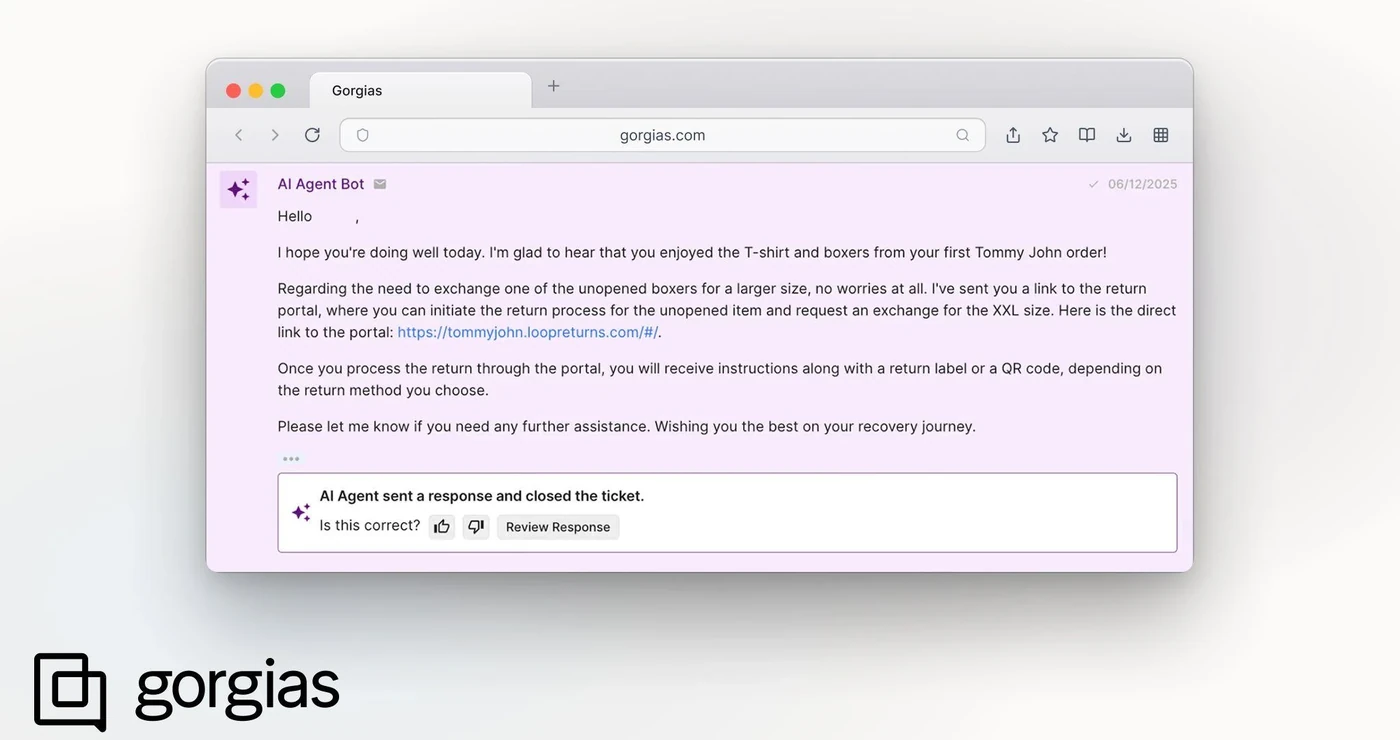
The verdict
If your problem is inbound questions rather than product discovery, Gorgias is the default for good reason.
Who it works best for
Shopify brands from SMB to mid-market, particularly in the US, doing over $1M in revenue. It's on 25,452 stores including NYTimes Store, Princess Polly, Steve Madden, Fashion Nova, Forever 21, Reebok and Timex.
Top features
One inbox for everything. Email, chat, social, SMS and voice in a single view with full order context, so an agent can refund or edit an order without leaving the ticket.
Ticket automation. Rules, macros and an AI agent that resolves common inquiries on its own.
Configurable behaviour. "Skills" bundle intent with instructions, "Guidance" sets rules per topic, plus a tone-of-voice setting. It learns from your help centre, Shopify product and order data, and uploaded documents.
Revenue attribution. Tracks revenue generated by support interactions, so customer service reports as a revenue line rather than a cost line.
Integrations
Shopify, WooCommerce, BigCommerce, Magento and Prestashop, with the Shopify integration being the deep one.
Pricing
Starter $40/mo (50 tickets, 30 AI interactions)
Basic $90/mo (300 tickets, 30 AI)
Pro $550/mo (2,000 tickets, 190 AI)
Advanced $1,430/mo (5,000 tickets, 530 AI)
Past your limit, AI interactions cost $1.50 each. There's a 7-day free trial and it's self-serve.
Two things to know before you budget. You can't buy the AI agent alone; it requires an active helpdesk subscription. And because the bill tracks tickets rather than traffic, it rises fastest exactly when your support volume peaks. Our reference brand at 1,000 tickets and 500 AI interactions a month lands around $1,015.
Gorgias pros
The most recognized helpdesk on Shopify, on 25,452 stores (source: Builtwith)
Native access to Shopify order history, customer data and catalog
Genuine channel coverage in one inbox, including voice
Self-serve with a low entry price if your ticket volume is small
Gorgias cons
Pricing is hard to forecast: helpdesk and AI are billed separately and both move with volume
No deep product catalog intelligence
Video
Alternatives in this bucket. Siena AI rates 4.8/5 on G2 across 28 reviews with volume-based pricing and no self-serve. Tidio is on 31,984 stores with Lyro AI from $39/mo, and is the cheapest way into this bucket.
Attentive: best for outbound conversational marketing
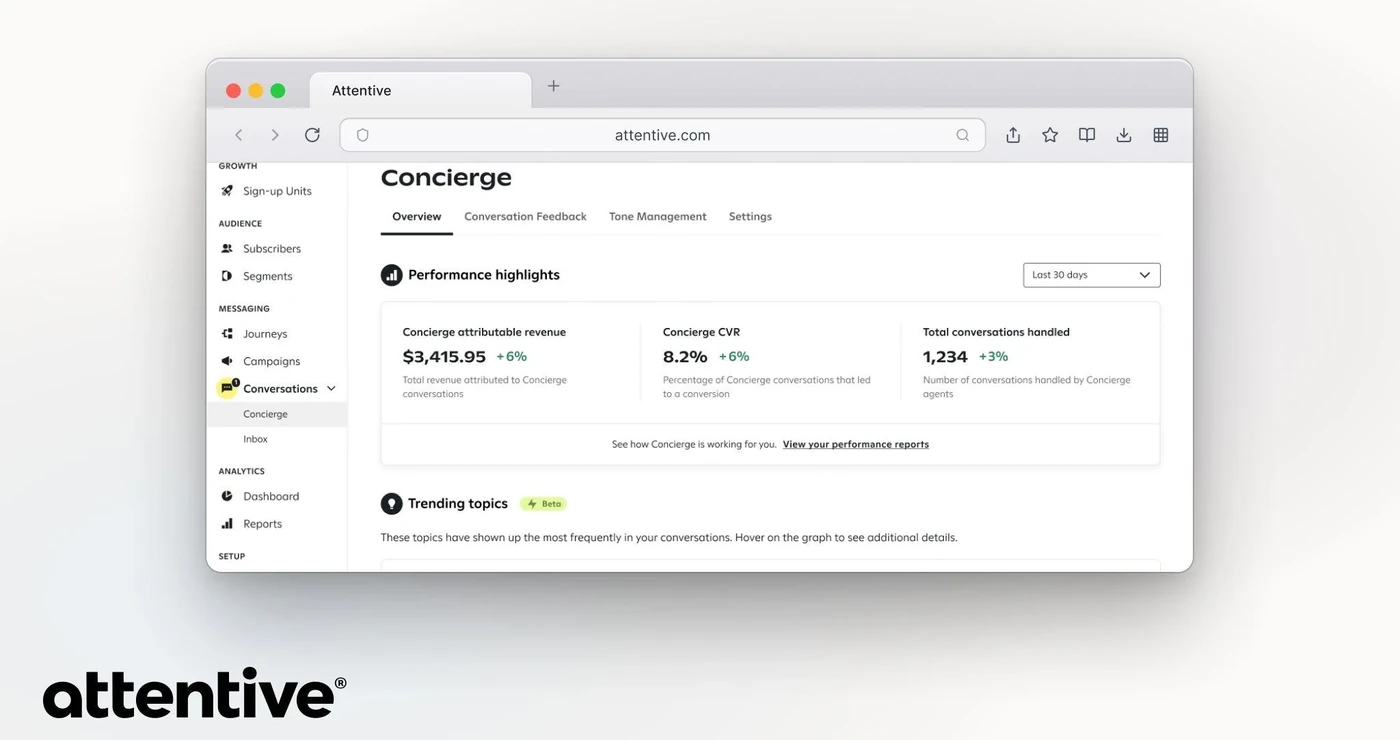
The verdict
If your problem isn't converting the visitors you have but bringing back the customers you had, this is a different purchase from the two above and Attentive is the category leader. It's a strong product with a pricing problem: they don't publish rates, there's no self-serve, and the real cost depends on message volume in a way that's easy to underestimate.
Who it works best for
Brands with an existing SMS program or the list size to justify starting one. Customers include Asics, Dyson, Patagonia and Tiffany, which is the enterprise end of DTC.
Top features
Subscriber growth tools. Sign-up experiences built to convert, including a mobile flow where tapping a pop-up opens the native messaging app with a pre-written opt-in text ready to send.
Multi-channel journeys. SMS, email and mobile push in personalized sequences.
Two-way SMS with AI. Subscribers can reply, and Attentive AI handles the response, recommending products or store locations.
Human escalation. When the AI can't resolve something, it hands off to a team member in the Conversations Inbox.
Note the scope of the AI here. Attentive's shopping assistant works over SMS only. If you want conversational help on your website, this is not the tool for that job.
Integrations
Adobe Commerce, BigCommerce, Shopify and Shopify Plus.
Pricing
Attentive doesn't publish pricing. Emotive (their biggest competitors) indicates a $100/mo platform fee, $0.01 per SMS, $0.03 per MMS, and $750/mo for shortcode rental, which would put our reference brand at roughly $1,050/mo for 20,000 messages. Treat those figures as indicative rather than quoted. There's a 30-day free trial, but no self-serve option, so a sales conversation is required.
Attentive pros
The clearest category leader in outbound SMS, with 4.5/5 on G2 across 1,483 reviews
Opt-in flow is genuinely well built, and list growth is the hard part of SMS
Two-way conversations with AI handling and clean human escalation
30-day trial is the longest here
Attentive cons
No public pricing and no self-serve, so evaluation starts with a sales call
Real cost scales with message volume, plus a $750/mo shortcode rental that surprises people
The AI assistant is SMS-only, so it does nothing for on-site conversion
Shortcode economics make it hard to justify for smaller lists
Alternatives in this bucket. Klaviyo rates 4.6/5 on G2 across 1,359 reviews and is the obvious choice if you want email and SMS from one vendor. Postscript rates 4.8/5 across 161 reviews and is Shopify-native, which makes it the lighter-weight option of the three.
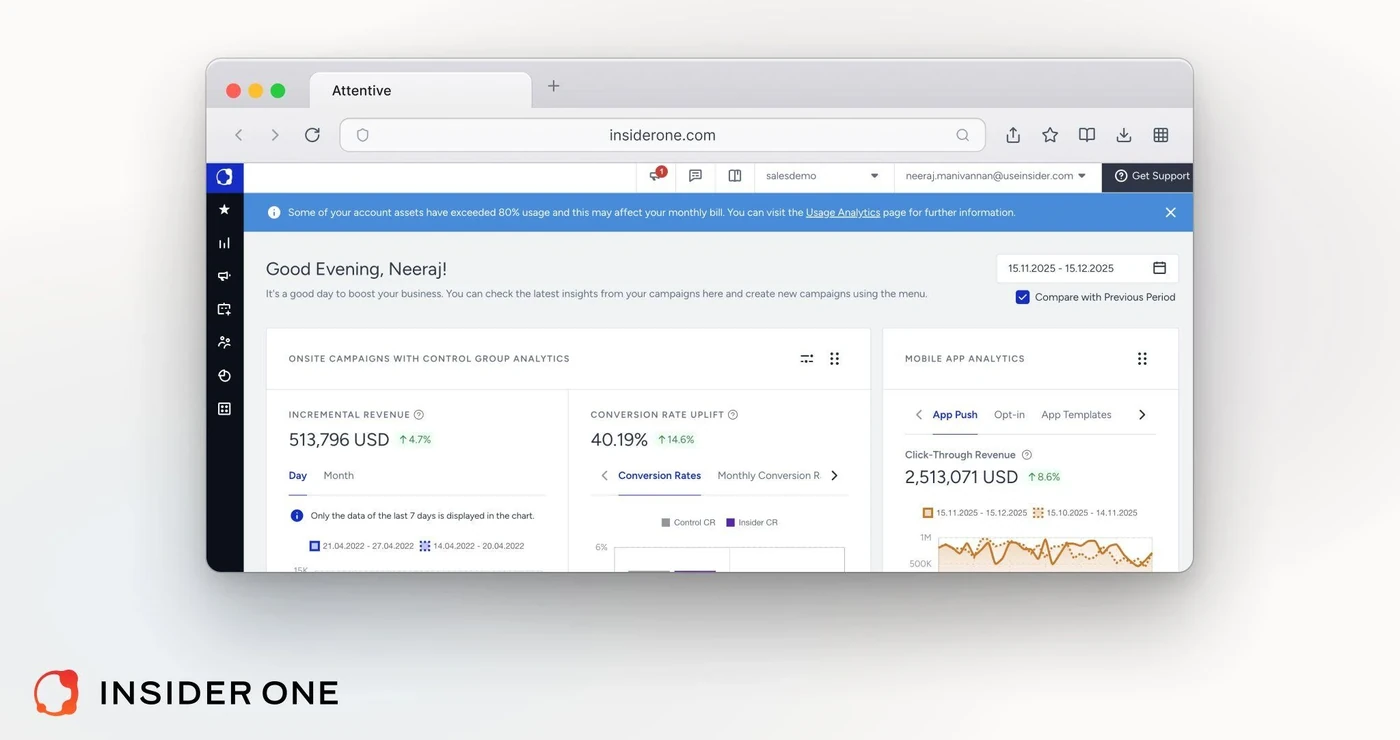
InsiderOne: best for enterprise engagement suites
The verdict
If you're an enterprise brand consolidating five martech contracts into one, InsiderOne is a serious answer and the 4.8/5 across 1,395 G2 reviews is the strongest review profile in this comparison. If you're anything smaller, the lack of public pricing, free trial or self-serve tells you plainly that you're not the customer.
Who it works best for
Enterprise. The customer list is Hyundai, Toyota, Samsung, Estée Lauder, Gap and Havaianas, and the product is priced and sold accordingly.
Top features
Customer data platform. Collects behaviour across website, app, email and messaging into one profile per customer.
Auto-segmentation and triggered campaigns. Cart abandonment, recommendation widgets, WhatsApp messages, built without engineering time.
Product recommendations at depth. 20+ strategies including bought-together, user-based and most-valuable-product, auto-optimized per slot by combining product attributes with user affinity.
AI site search. Search and recommendation engine over the catalog.
Agent One (launched May 2026). Three bundled agents: a shopping agent that proactively engages and recommends, a support agent, and an insights agent.
Integrations
Shopify, VTEX and Kobe on the commerce side. As a CDP it's designed to sit across your whole stack rather than plug into one platform.
Pricing
Not published. There's no free trial and no self-serve option, and the Shopping Agent is bundled into the suite rather than sold standalone. For our reference brand that means the answer is a sales conversation and a suite purchase, which is a real finding rather than missing data.
InsiderOne pros
Strongest review profile here: 4.8/5 on G2 across 1,395 reviews
Genuine consolidation play, replacing several tools with one contract
Product recommendation engine is the deepest in this comparison
Enterprise customer list that de-risks the decision for a large buyer
InsiderOne cons
No public pricing, no trial, no self-serve
The shopping agent can't be bought on its own, so you're buying the suite
Agent One only launched in May 2026, so it's the least proven part of a mature product
Only 20 Shopify app ratings, which suggests Shopify isn't where its strength lies
Video
Alternatives in this bucket. Bloomreach is the closest comparable at 4.6/5 on G2 across 769 reviews, though its Shopify app rating sits at 2.7/5 across 6 ratings, which is worth investigating if Shopify is your platform.
The fifth type: agentic commerce
Everything above assumes the shopper eventually reaches your website. Agentic commerce is what happens when they don't.
A customer asks ChatGPT which running shoe suits flat feet. The assistant recommends, and increasingly can complete the purchase without the shopper visiting a single brand site. The conversation is real, the commerce is real, and none of it happens on a property you control.
There's no platform to review here yet, which is why this section has no verdict and no pricing table. What exists is closer to plumbing: OpenAI, Google and Stripe have all shipped agent-payment infrastructure over the past year, and the vendor products sitting on top of it are early.
The reason to care now rather than in a year: the work of encoding your catalog and your sales expertise into an agent is the same work whether that agent runs on your product page or inside someone else's assistant. Brands doing it for on-site discovery today are, incidentally, doing the hard part of agentic commerce early.
Conclusion
Pick the bucket before you pick the tool. Discovery, support, outbound and enterprise suites are four different purchases. Most disappointment with conversational commerce comes from buying the wrong one, not from the category failing.
Choose Dialog if shoppers can't find the right product. Built for pre-purchase discovery, $399/mo at 50,000 visitors, self-serve on Shopify with a free tier so you can test it first.
Choose Gorgias if you're drowning in tickets. The Shopify helpdesk default with a capable shopping assistant attached, at roughly $1,015/mo for our reference brand. Just don't buy it to solve discovery.
Choose Attentive if the problem is retention. The outbound SMS leader, with the caveat that pricing is opaque and shortcode rental adds a fixed $750/mo before you send anything.
Choose InsiderOne if you're enterprise and consolidating. Best review profile here, and the clearest "you'll be talking to sales" signal in the group.
Price on your own numbers, not the headline plans. Traffic, tickets and messages are three different meters. The cheapest plan and the cheapest outcome are rarely the same tool.