


TL;DR
We tested and reviewed eight AI shopping assistants for this guide. Here is the short version:
Dialog is best for mid-market and enterprise brands with complex or high-consideration catalogs (25K+ monthly visitors on Shopify, 100K+ on other platforms) because it embeds a sales-trained AI agent directly in the product page, connects to the live catalog, and proves its impact with native A/B testing visible in GA4. Plans start at $249/month.
Rep AI is best for US-based Shopify mid-market brands that want proactive selling because its behavioral AI detects hesitation and exit intent, then starts the conversation itself. Reviewers report conversion and AOV lifts, with plans from $12/month for 3,000 sessions.
Shopify Inbox AI Sales Associate is best for very small Shopify merchants because it is free, native to the platform, and takes minutes to activate, even if its answers stay generic compared to specialized tools.
The other five tools we review (Gorgias, Bloomreach Clarity, Insider One, Constructor, and Luigi’s Box) each fit a specific profile, from helpdesk-first brands to enterprise retailers.
Introduction
Walk into a good physical store, and someone greets you, asks what you need, and puts the right product in your hands.
Open an online store, and you get a search bar, some filters, and silence. That gap has a measurable cost: according to an Episerver study, companies lose 97% of online purchasers due to incorrect or incomplete content on their owned channels.
AI shopping assistants exist to close that gap. They are conversational agents that sit on your store (or inside ChatGPT and other AI surfaces), understand your catalog, and guide shoppers to the right product the way a trained salesperson would. The scale of that shift is already measurable: according to Lyro's AI in E-Commerce in 2026 report, 37% of U.S. AI users now start product searches with an AI tool rather than a search engine, and AI-referred traffic to retail sites grew 632% year-over-year.
The category has exploded since 2023. Helpdesks added shopping modes, search vendors added conversational layers, and a new generation of AI-native tools appeared. The result is a confusing market where “AI shopping assistant” can describe anything from a free chat widget to a six-figure enterprise suite.
This guide cuts through that noise. We compare eight AI shopping assistants across very different profiles: a product-page-first specialist (Dialog), a proactive behavioral agent (Rep AI), a helpdesk add-on (Gorgias), a free native tool (Shopify Inbox), two enterprise suites (Bloomreach, Insider One), and two search-first platforms (Constructor, Luigi’s Box).
For each one, you will learn what it does well, what it costs, and what real reviewers say about it. By the end, you should know exactly which AI shopping assistant capabilities matter for your store, and which tool fits your team size and budget.
What is an AI shopping assistant?
First things first, let’s define the category.
AI shopping assistant definition
An AI shopping assistant is a conversational agent that helps customers find, understand, and choose products in an online store. It connects to the store’s catalog, reads the product data and documentation, and answers questions in plain language. Think of it as the online version of a knowledgeable sales associate: someone who asks what you need, then puts the right product in your hands.
This is a real break from the chatbots of the last decade. Older bots followed scripted decision trees and could only match keywords. A modern AI shopping assistant understands intent. A shopper can type “something warm for hiking that isn’t bulky” and the agent surfaces the right jacket, even if none of those words appear in the product title.
What can an AI shopping assistant do?
The capabilities vary by tool, but the strongest ones cluster around a few jobs:
Answer product questions. It handles specifications, compatibility, sizing, and objections at the moment a shopper hesitates, without waiting for a human agent.
Guide discovery. It recommends products across the catalog based on a conversation, replacing static filters and category pages.
Search by intent. It interprets natural-language queries rather than exact keywords, so shoppers find products even when they don’t know the right term.
Re-engage hesitant shoppers. Advanced assistants follow up based on what a customer asked but did not buy.
Report on impact. They track conversations and tie them to conversion, so you can measure what the agent actually drives.
The line between an “AI shopping agent” and an advanced AI shopping assistant is mostly about autonomy. Basic tools react when a shopper opens the chat. More advanced ones act on their own: they detect buying signals, start the conversation, and increasingly follow the shopper beyond the website into surfaces like ChatGPT.
How we selected our recommendations
Before we share our recommendations, let us explain our selection process.
To avoid being partial, we grounded this comparison in first-hand testing and third-party evidence:
We test the products whenever they offer a free trial. When a trial is not available, we go through every product tour, demo video, and piece of documentation the vendor publishes.
We read at least 50 G2 reviews for each product (when that many exist) to get a real sense of strengths and weaknesses. We complement them with Trustpilot and Shopify App Store reviews whenever those are available.
One note on transparency: Dialog, the first tool in this list, is our own product. We took as many precautions as possible to present it accurately, including citing the same review sources we used for every other tool and being explicit about who it is not for.
Dialog — Best for brands with complex or high-consideration catalogs
What is Dialog?
Dialog is an AI sales agent for ecommerce, founded in 2022 and used by 300+ brands including Shiseido, Oh My Cream, MG Motor, Delsey, and Manucurist.
Dialog’s core idea is that e-commerce sites are glorified spreadsheets. Categories, filters, and search bars were designed around the technical limits of the early 2000s, not around how customers actually decide.
Dialog replaces that navigation with a conversation: an AI shopping assistant embedded directly on the website, trained on the brand’s catalog, documentation, and sales expertise.
Its ideal customer is a mid-market or enterprise brand (25K+ monthly visitors on Shopify, 100K+ on other platforms) selling products that require real expertise to choose: skincare routines, technical equipment, premium goods with large catalogs.
Why Dialog is a good AI shopping assistant
It lives where the decision happens. The AI PDP Assistant sits on the product page itself, answering technical questions and handling objections at the exact moment a shopper hesitates. Most competitors park their assistant in a corner widget.
It covers the full pre-purchase journey. Smart Search understands intent rather than keywords. The personal shopper runs a full conversational discovery flow across the catalog. Smart Reengagement identifies hesitant shoppers based on what they asked but did not buy, captures their email or phone number directly in the conversation, and pushes the contact into Klaviyo (or any connected ESP/CRM) to trigger the right follow-up.
It connects to a 360° view of the store. Dialog ingests the live catalog, internal documentation, and SEO content. When the catalog changes, the assistant follows automatically, with no manual updates.
It proves its own ROI. Native A/B testing shows the conversion delta directly in GA4. In one A/B test with the brand Karacare, Dialog’s Personal Shopper delivered +14.5% revenue per visitor against a Typeform quiz.
It turns every conversation into intelligence. Each question a shopper asks the assistant is logged and analyzed, surfacing recurring objections, unmet product needs, and gaps in the catalog or content, turned into a reporting layer brands use to inform merchandising, content, and product decisions.
It extends beyond the website. Dialog deploys the same branded agent inside ChatGPT via ChatGPT Apps, so the brand keeps control of how AI platforms sell its products.
What reviewers say about Dialog
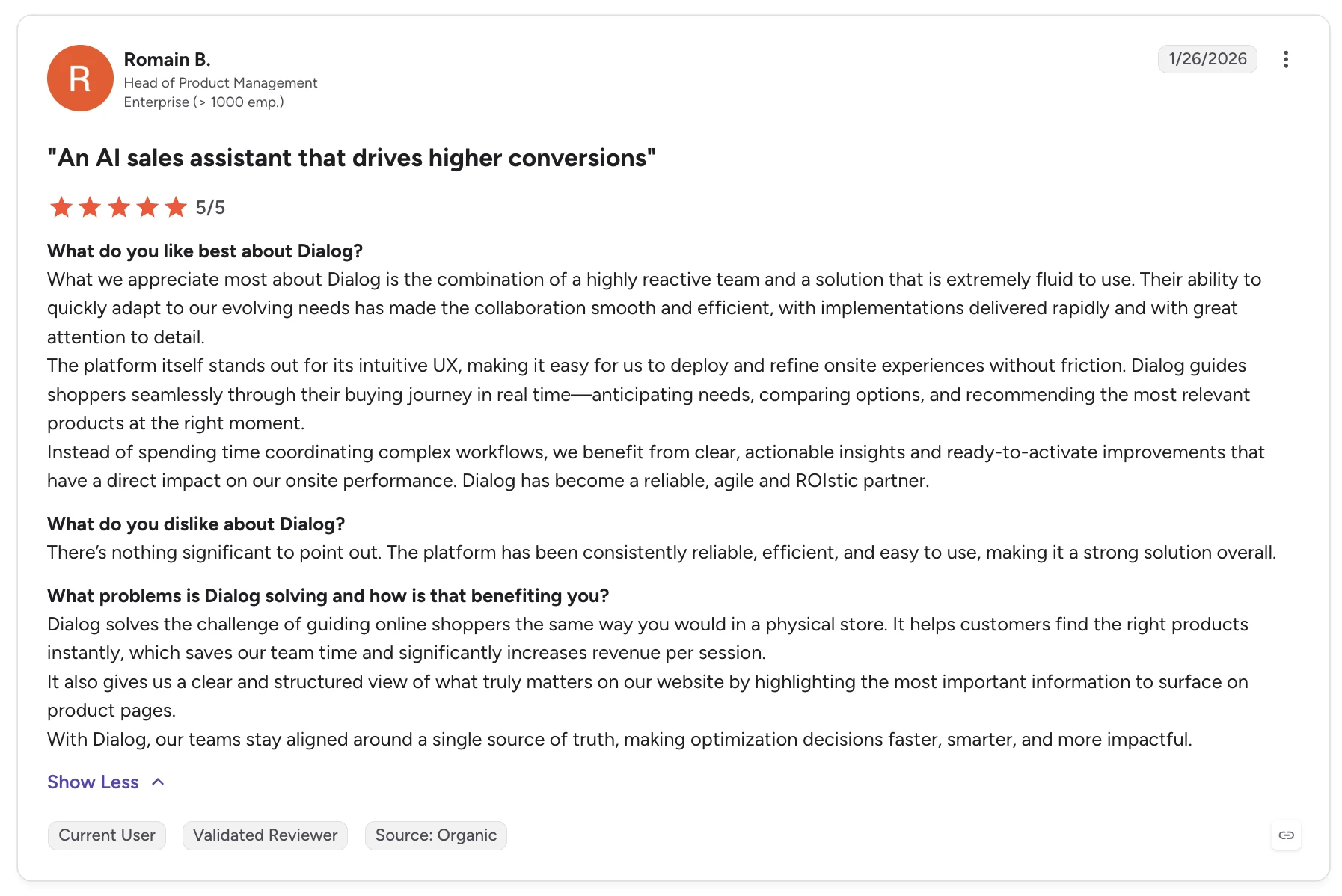
Dialog holds a 5/5 rating on G2 (10 reviews) and 5.0/5 on the Shopify App Store (32 reviews). The review volume is still small, so treat these averages with the appropriate caution.
Main pros:
Standalone product: you do not have to buy a whole suite to get the AI shopping assistant.
360° store knowledge: it combines catalog data, internal docs, and SEO content, which reviewers say produces noticeably more precise answers.
Detailed analytics that surface which questions buyers ask, including gaps to cover in your documentation.
Main cons:
It is not a full suite, which can be a drawback if you want support, marketing, and sales centralized in one tool.
It is a newer product compared to legacy platforms, with a shorter track record.
Demo video of Dialog
Rep AI — Best for US Shopify brands that want proactive selling
What is Rep AI?
Rep AI is a conversational AI platform founded in 2021 after its founder got rescued by a great sales associate in a sportswear store and could not recreate that experience online. It positions itself as an “Agentic Commerce Operating System” that combines an AI shopping agent with support and helpdesk features. It is used by around 1,000 stores, almost exclusively in the US, including AMIRI, 7 For All Mankind, and OLLY. Its sweet spot is Shopify mid-market brands in fashion, health, and outdoor.
Why Rep AI is a good AI shopping assistant
It sells proactively. Behavioral AI monitors shopper actions (product comparisons, repeat browsing, exit signals) and starts a contextual conversation when it detects hesitation or buying intent. Most AI shopping assistants wait to be asked.
It handles discovery, upsell, and support in one widget. The agent recommends products, cross-sells, and answers FAQs, then hands off to Gorgias, Zendesk, or Help Scout when a human is needed.
It works across channels. The same AI operates on on-site chat, email, Instagram and Facebook DMs, and WhatsApp, with conversations connected across channels.
Entry pricing is accessible. Plans start at $12/month for 3,000 sessions and scale to $2,390/month for 500,000 sessions, with a 30-day free trial. Note that pricing is session-based, so bills can spike during flash sales or traffic peaks.
What reviewers say about Rep AI
Rep AI scores 4.9/5 on G2 (62 reviews) and 4.7/5 on the Shopify App Store (111 reviews).
Main pros:
Excellent customer support and dedicated account managers (the single most mentioned point, 28 occurrences in our G2 sample).
Measurable lifts in sales, conversion rate, and AOV; one reviewer reports “7-10%+ increase in sales” from the chat.
Fewer support tickets thanks to 24/7 automated answers.
Easy setup and smooth Shopify Plus integration.
Main cons:
AI responses occasionally need tweaking and can answer incorrectly, so reviewers recommend regular review of the transcripts.
Pricing is on the higher side for what some teams need.
The backend is technical, and building flows is “difficult and manual” according to several reviewers.
Reaching full effectiveness takes time; one reviewer says “it takes a good month to get everything up and running.”
Demo video of Rep AI
Gorgias Shopping Assistant — Best for brands already on the Gorgias helpdesk
What is Gorgias?
Gorgias is the leading ecommerce helpdesk, founded in 2015 and used by more than 25,000 stores including Steve Madden, Princess Polly, and Fashion Nova. Its core product unifies email, chat, social, SMS, and voice into one inbox with full Shopify order context. In 2025, it introduced an AI shopping assistant that proactively engages browsers before they buy, answers product questions, recommends items, and can offer intent-based discounts when it detects hesitation.
Why Gorgias is a good AI shopping assistant
Deep native Shopify data access. The assistant draws on orders, customer history, and the product catalog, which few standalone tools can match out of the box.
Configurable selling behavior. You shape the assistant with “Skills” (intent plus instructions bundles), “Guidance” (custom rules per topic), and a tone-of-voice setting. It learns from your help center, Shopify data, and uploaded docs.
One vendor for pre-sale and post-sale. If Gorgias already runs your support, adding the Shopping Assistant means no new contract, no new widget, and one unified conversation history.
Vendor-reported results are strong. Gorgias’s 2026 report claims a 154% higher conversion rate for shoppers who had an AI conversation (treat this as a vendor claim).
What reviewers say about Gorgias
Gorgias scores 4.6/5 on G2 (562 reviews) and 4.2/5 on the Shopify App Store (651 reviews). But most reviews cover the helpdesk rather than the newer Shopping Assistant specifically.
Main pros:
Best-in-class Shopify integration and order context inside every ticket.
Massive ecosystem and brand recognition; it is the default helpdesk choice for DTC brands.
Main cons:
Product discovery is a reported weak spot. One beauty brand evaluating alternatives wrote that “its AI capabilities are relatively limited for our needs, especially when it comes to product discovery and recommendation.”
Pricing is hard to predict: the assistant costs $0.90 to $1 per resolved conversation on top of the helpdesk subscription ($10 to $750/month), so costs can spike during Black Friday.
You cannot buy the AI agent alone; an active helpdesk subscription is required.
Its DNA is support-first, and some users report occasional hallucinations in real usage.
Demo video of Gorgias
Shopify Inbox AI Sales Associate — Best for very small Shopify merchants
What is Shopify Inbox AI Sales Associate?
Shopify Inbox is Shopify’s free, native messaging tool. In its Spring 2026 edition, Shopify added an “AI Sales Associate” mode: proactive product recommendations with native access to your catalog, at zero cost and with zero installation friction. It targets the smallest merchants, the ones who would otherwise have no shopping assistant at all, and today it is mostly used to reduce support tickets.
Why Shopify Inbox is a good AI shopping assistant
It is free. No subscription, no per-conversation fee, no session cap. For a merchant doing a few thousand visits a month, that alone settles the debate.
Zero-friction setup. It is already available on every Shopify store; you activate it rather than install it.
Native catalog access. The AI reads your Shopify products directly, so recommendations always reflect what you actually sell.
It improves on its own. Shopify ships updates continuously, so the assistant gets better without any effort on your side.
What reviewers say about Shopify Inbox
Unfortunately, the AI Sales Associate mode is too recent to have its own review base, and we haven’t found a single example of a store using it in the wild yet.
Demo video of Shopify Inbox AI Sales Associate
https://fast.wistia.net/embed/iframe/2sb90qi1w4
Bloomreach Clarity — Best for enterprises already on the Bloomreach suite

What is Bloomreach?
Bloomreach is an AI-powered ecommerce personalization platform founded in 2009, with $452M raised and customers like The North Face, Patagonia, Pandora, and Desigual. Its suite spans marketing automation (Engagement), site search and merchandising (Discovery), a headless CMS (Content), and Clarity, its conversational shopping assistant released in 2023. The whole platform runs on its AI layer, Loomi.
Why Bloomreach is a good AI shopping assistant
The AI assistant taps the full customer profile. Because it sits on Bloomreach’s CDP, the assistant can personalize conversations using behavioral data collected across web, app, email, and messaging.
One data model across the suite. Segments, journeys, personalization, and the shopping AI assistant all run on the same data, which removes the integration work standalone tools require.
Enterprise-grade personalization pedigree. Bloomreach has run search and recommendations for major retailers for over a decade, and Clarity inherits that machinery.
What reviewers say about Bloomreach
Bloomreach scores 4.6/5 on G2 (769 reviews) but only 2.7/5 on the Shopify App Store (6 ratings), which reflects that Shopify is not its natural habitat. Reviews cover the whole suite; Clarity-specific feedback is still rare.
Main pros:
All-in-one unified platform: “segments, journeys, email, web personalisation and predictions all run on the same data.”
Intuitive UI once you are ramped up.
Extremely flexible: “there are hardly any limitations with Bloomreach.”
Excellent customer support, CSMs, and training.
Main cons:
Steep learning curve; the most cited complaint (15 occurrences in our sample). “At times too complex to set up.”
Reporting is shallow and custom reports are hard to build.
Documentation and tutorials need work.
No public pricing, and Clarity cannot be bought standalone; it comes bundled with the suite.
Demo video of Bloomreach
Insider One Agent One — Best for enterprise omnichannel retailers

What is Insider One?
Insider One (formerly Insider) is a customer engagement platform founded in 2012 that has raised $1 billion since its inception. It unifies behavioral data from web, app, email, and messaging into a single customer profile, then triggers personalized campaigns across channels. Customers include Samsung, Estée Lauder, Hyundai, and Gap. In May 2026, it announced Agent One, which bundles three agents: a Shopping Agent that proactively engages shoppers and recommends products, a Support Agent, and an Insights Agent.
Why Insider One is a good AI shopping assistant
The Shopping Agent rides on a real CDP. It can use everything the platform knows about a customer (past purchases, channel behavior, segments) to shape its recommendations.
Omnichannel by default. The same intelligence reaches shoppers on the website, in the app, and over WhatsApp, SMS, and email.
Three agents in one release. Shopping, support, and insights agents share the same data layer, which suits enterprises consolidating their AI vendors.
Proven scale. BuiltWith counts around 29,000 websites using Insider technology, far beyond most tools in this list.
What reviewers say about Insider One
Insider One scores 4.8/5 on G2 (1,395 reviews) and 4.6/5 on the Shopify App Store (20 ratings) but most reviews cover the engagement platform; the shopping assistant is too recent for a dedicated review base.
Main pros:
Easy to use, intuitive interface (most cited pro).
Responsive support with dedicated local customer success teams.
The Architect journey builder automates workflows with low engineering dependency.
Genuine omnichannel reach: email, push, SMS, WhatsApp, in-app.
Main cons:
Steep learning curve and long onboarding for a wide, feature-heavy platform.
Feature gaps in specific modules (native integrations, gamification, B2B segmentation).
Journey building can be rigid for advanced cases.
Expensive, with inflexible pricing; the Shopping Agent is bundled and cannot be bought standalone.
Demo video of Insider One
Constructor — Best for enterprise retailers with search-led discovery
What is Constructor?
Constructor is an AI-powered search and product discovery platform built for enterprise ecommerce, founded in 2015 by former Shutterstock engineers and used by Sephora, Under Armour, Gap, and Foot Locker.
Its core is search and autosuggest driven by clickstream data. On top of that, it now offers an AI Shopping Agent for conversational product discovery and a Product Insights Agent that answers personalized product questions; the retailer Lightopia saw a 52% increase in add-to-cart rate from shoppers engaging with that agent (again, the data is provided by Constructor so take it with a pinch of salt).
Why Constructor is a good AI shopping assistant
The agent learns from real behavior. Constructor’s ranking is trained on what shoppers actually click and buy, so conversational recommendations inherit years of behavioral optimization.
Natural-language discovery at enterprise scale. Shoppers describe what they want in plain language and the AI shopping agent guides them to products, across fashion, furniture, and grocery catalogs.
Discovery and monetization in one platform. Constructor serves both organic and sponsored results from the same engine, which matters for retailers running retail media.
A real trial for an enterprise tool. Constructor offers a 4-week free trial, rare at this end of the market.
What reviewers say about Constructor
Constructor scores 4.8/5 on G2 (58 reviews). Its Shopify app has no reviews yet, and we found no Trustpilot base, so G2 is the only meaningful source here.
Main pros:
AI search and ranking that visibly improves from real user behavior: “it actually learns from user behavior and adjusts results in real time.”
Easy to use for non-technical business users.
Measurable revenue impact; reviewers cite RPV and conversion lifts.
Powerful merchandising control without developer help.
Main cons:
Analytics and data export could be more robust.
Catalog and data-feed management can be fiddly with daily CSV processing.
Changes are not instant; catalog syncs and rule updates take time to propagate.
A/B testing lacks granularity for advanced use cases.
Demo video of Constructor
Luigi’s Box — Best for mid-market stores upgrading site search
What is Luigi’s Box?
Luigi’s Box is an AI-powered product search and discovery platform founded in Slovakia in 2014, used by around 2,200 websites including whiskyshop.com and Under Armour CZ.
It offers site search, recommendations, category listing, analytics, and, more recently, a conversational shopping agent. That agent focuses strictly on product discovery: it appears inside search results, autocomplete, or as a fixed button, and it does not handle support questions.
Think of it as an extension of site search rather than a proactive sales agent.
Why Luigi’s Box is a good AI shopping assistant
Search quality is the foundation. Its search handles typos, synonyms, and intent unusually well, and the conversational agent builds on that relevance engine.
Modular buying. You can license only the products you need (search, recommendations, or the agent) instead of committing to a full suite.
Broad platform support. It integrates with Shopify, Magento, Shopware, PrestaShop, WooCommerce, BigCommerce, and more, which suits European stores on diverse stacks.
Low-risk evaluation. A 30-day free trial lets you benchmark it against your current search before paying.
What reviewers say about Luigi’s Box
Luigi’s Box scores 4.8/5 on G2 (425 reviews) and 4.2/5 on the Shopify App Store (10 reviews).
Main pros:
Accurate, relevant search that handles typos, synonyms, and user intent (by far the most cited strength, 17 occurrences in our sample): “it does a great job of understanding user intent, even with imperfect queries.”
Main cons:
A learning curve at the start; initial configuration and tuning take time, and reviewers ask for better onboarding documentation.
The conversational agent stays reactive and discovery-only; it will not proactively engage hesitant shoppers or handle pre-purchase objections on the product page.
Demo video of Luigi’s Box
AI Shopping Assistants examples
What’s the best way to understand how AI shopping assistants can help your store? Check a real-life example!
We’ve gathered a list of stores that use one so you can try them.
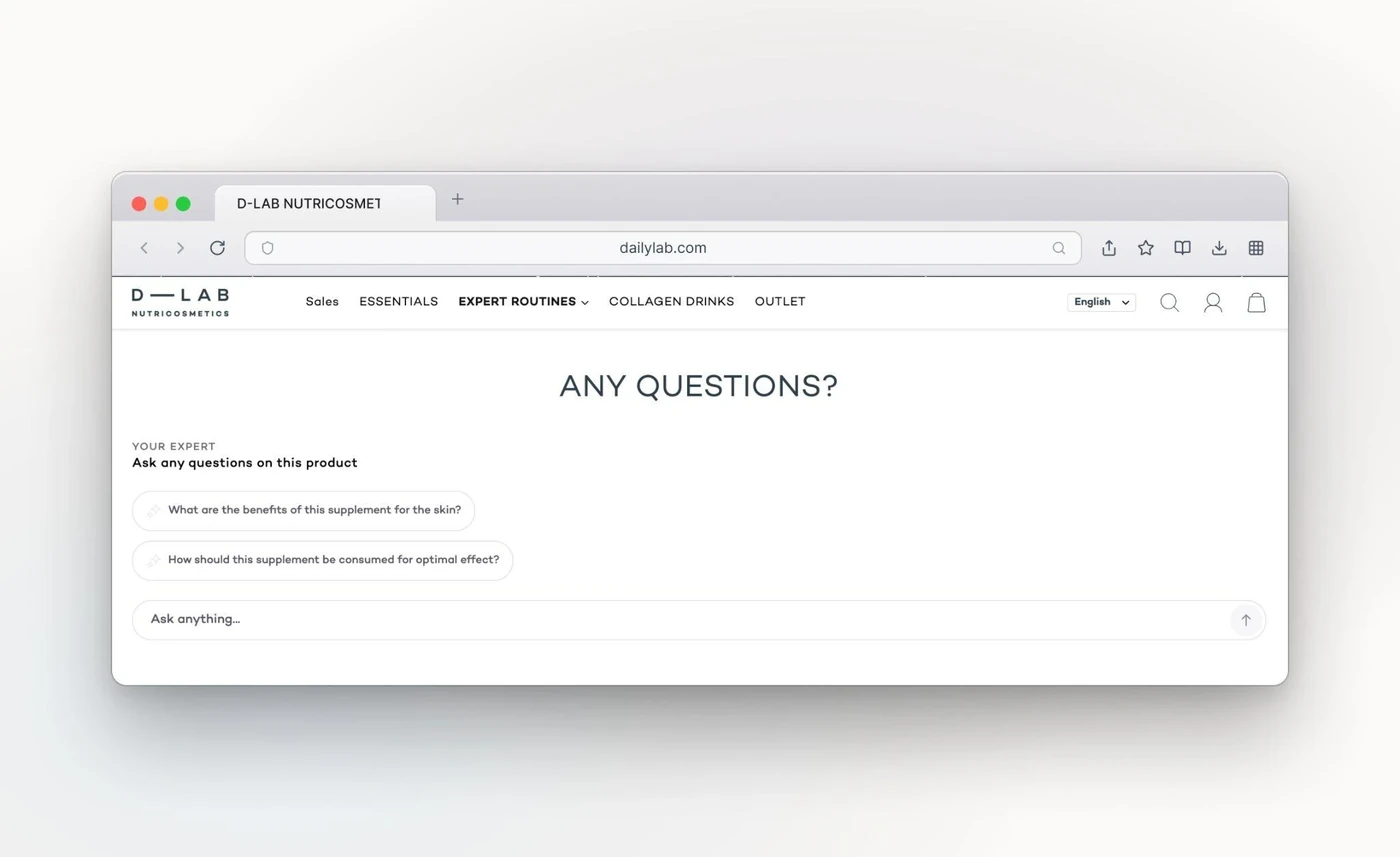
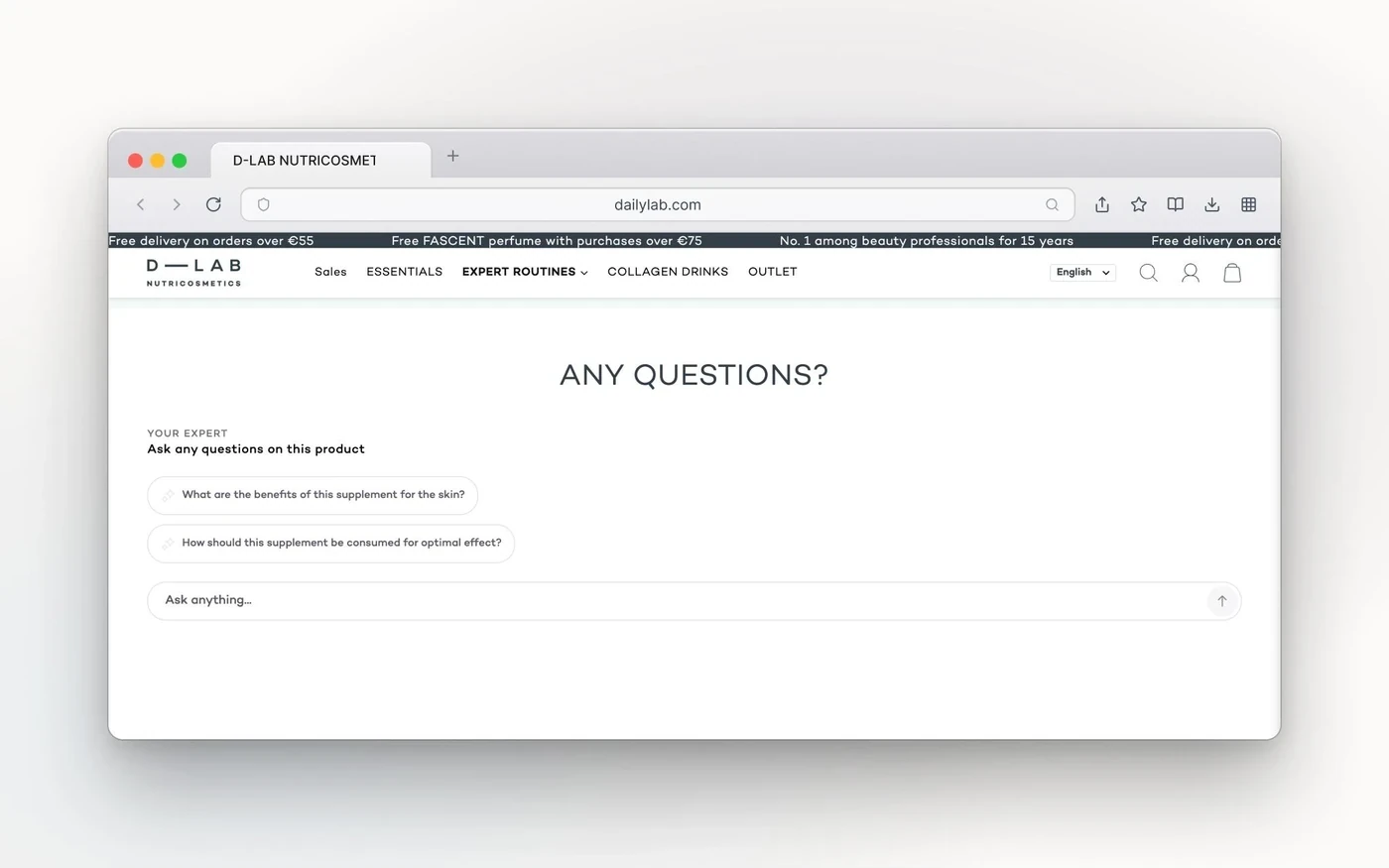
Dailylab.co.uk
You can find their AI assistant on the product pages:
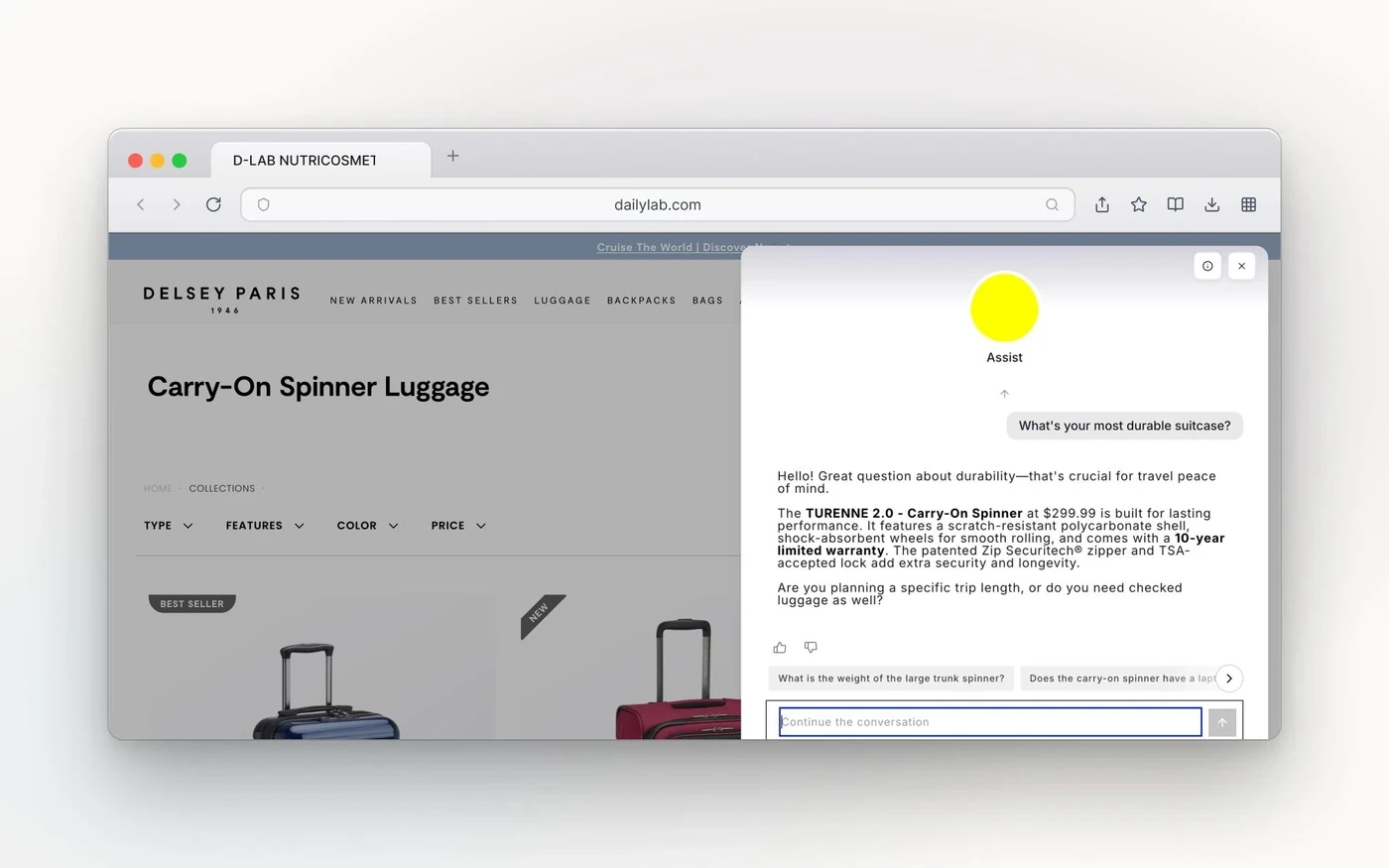
Delsey.com
Delsey Paris lets you ask questions to their shopping assistant directly from the collections pages.
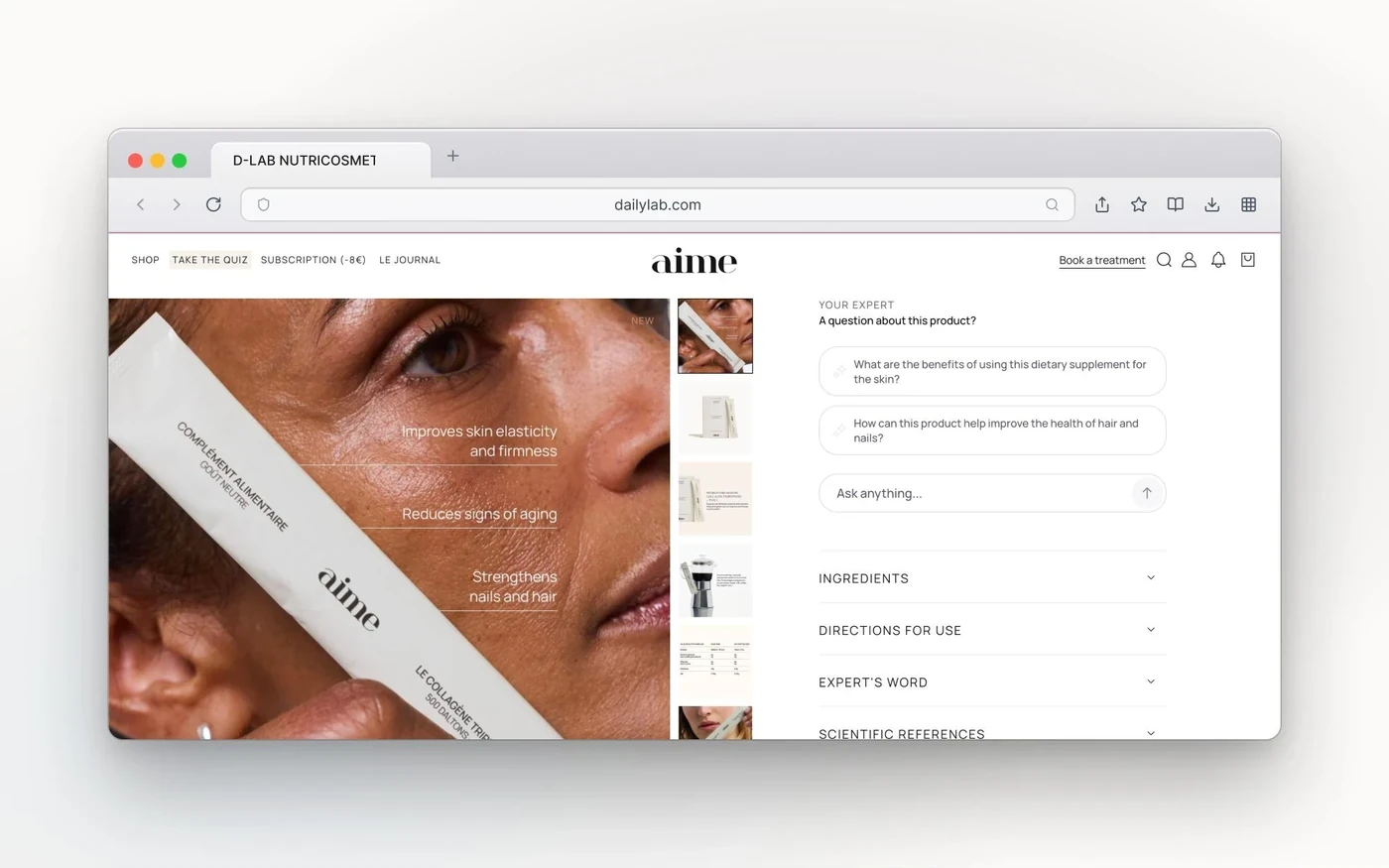
Aime.co
Aime displays their AI assistant as an embed on product pages.
Conclusion
The best AI shopping assistant depends less on the AI and more on your store: your size, your catalog complexity, and what you already run. Here is how the eight tools break down:
Dialog: mid-market and enterprise brands with complex, high-consideration catalogs that want a sales-first agent on the product page, with A/B-tested proof of impact. From $249/month.
Rep AI: US Shopify mid-market brands that want the assistant to open the conversation, not wait for it. From $12/month, session-based.
Gorgias Shopping Assistant: brands already running Gorgias support that want to extend it to pre-sale, accepting weaker product discovery. $0.90 to $1 per resolved conversation on top of the helpdesk plan.
Shopify Inbox AI Sales Associate: very small Shopify merchants who want a free, native shopping assistant with zero setup.
Bloomreach Clarity: enterprises already invested in the Bloomreach suite that want a conversational layer on their CDP.
Insider One Agent One: enterprise omnichannel retailers consolidating shopping, support, and insights agents on one data layer.
Constructor: enterprise retailers whose discovery strategy starts with search and who want an AI shopping agent trained on clickstream behavior.
Luigi’s Box: mid-market stores that primarily need better search, with a discovery-focused conversational agent on top.
If you sell products that customers need to understand before they buy, prioritize tools with deep catalog intelligence and product-page presence. If your main pain is ticket volume, a support-first tool will serve you better. And if you are just starting, take the free option, measure, and upgrade when the conversations outgrow it.