



Article overview
The right Shopify product recommendation app depends on what is costing you sales. We priced each tool for the same store: 50,000 monthly visitors, 1,000 orders and 25,000 email subscribers.
Wiser AI, for bigger orders. It adds “frequently bought together”, cart and post-purchase recommendations across the store, and merchants rate it 4.9 from 555 reviews. It costs $99/mo at 1,000 orders and $199/mo in a busy November.
Dialog, for shoppers who can’t decide. An AI assistant answers questions on product pages and guides shoppers to the right product in conversation. It’s priced on traffic: $399/mo at 50,000 visitors.
Octane AI, for small catalogs. A product quiz recommends from a short set of answers and grows your email list along the way. It costs $140/mo on the entry plan with overage, or $200/mo on Plus, at 1,000 quiz completions.
Stacking everything is expensive. Wiser, Dialog, Klaviyo and Octane together cost about $1,038/mo before popups, billed on four different units (orders, visitors, profiles and quiz credits). Start with the tool that fixes your biggest problem, and add the next one when that channel proves itself.
Introduction
A Shopify product recommendation app pays off when shoppers use it.
A Monetate analysis of shopping sessions, reported by eMarketer, found that browsers who engaged with a recommended product had a 70% higher conversion rate during that session.
This stat is from a few years ago. With the latest developments of GenAI, we can assume product recommendations have an even bigger impact today.
This guide covers both: traditional behavioral recommendations and GenAI recommendations.
We start with Shopify’s free default, then review the best apps by approach and channel, with real merchant reviews for each.
Shopify product recommendation apps compared
Platform | Approach | Starting price | Shopify rating |
|---|---|---|---|
Shopify Search & Discovery | Native related recommendations and hand-picked complementary products | Free | 2.7 (509) |
Wiser AI | On-site widgets and upsells | $9/mo (51 to 100 orders). Free up to 50 orders, 14-day trial, self-serve. | 4.9 (555) |
Dialog | Conversational product discovery | $249/mo (25,000 visitors). Free plan (200 conversations), free trial, self-serve on Shopify. | 5.0 (36) |
Klaviyo | Email recommendations | $20/mo (500 profiles). Free plan (250 profiles), self-serve. | 4.7 (3,293) |
Octane AI | Product quizzes | $50/mo (400 credits, 2 quizzes). 14-day trial, self-serve. | 4.7 (206) |
Wisepops | Popup and on-site recommendations | From €499/mo. Pricing after a demo. | 4.9 (70) |
InsiderOne | All-in-one engagement suite | Not published. No trial, sales-led. | 4.6 (18) |
Why Shopify’s native recommendation app is not enough
Should you just use Shopify’s native app to power your product recommendations?
We don’t think so.
Shopify ships two kinds of recommendations, managed through its free Search & Discovery app:
Related products (“You may also like”) are generated automatically.
Complementary products (“Pair it with”) have to be set by hand, product by product.
Both appear only where your theme has a section for them.
On paper, that covers the basics. In practice, Search & Discovery holds a 2.7 out of 5 on the Shopify App Store from 509 reviews. Of the 50 most recent reviews (April to September 2026), 36 give it one or two stars.
The recommendation complaints fall into three buckets.
The automatic suggestions don’t understand your catalog. Related products are generated with no merchant rules, so the pairings can be absurd. Other merchants report the algorithm drifting toward whatever sells most, which is the one list a shopper could have found without help.
“I get auto-generated ones that don’t make sense, like a ring and a baby onesie.” Staci Styles, 4 stars, September 2025
You can’t set rules. There’s no way to say “recommend from this collection” or “never show wholesale items”. One merchant found hidden wholesale products and prices appearing in front of retail customers.
“It has started revealing my wholesale products and prices to people in the recommendation section.” Soy and Shea, 3 stars, June 2026
The manual option doesn’t scale. Complementary products are set one product at a time. That’s an afternoon for a 40-SKU store. For a store with 2,000 SKUs, it looks too big of a task.
To be fair, it’s free, and small stores with a tight catalog are mostly content. “For a free app it works quite well,” writes Illusions Lingerie.
If you sell 30 products and can hand-pick every pairing, start here. Everyone else ends up adding at least one of the apps below, and the first one most stores reach for is a better widget.
The best Shopify product recommendation apps by approach
1. Wiser AI: best for classic on-site recommendations
Shopify rating: 4.9/5 (555 reviews)
Wiser AI overview
Wiser is the app to install if you want Amazon-style widgets across the whole store on a small-store budget. It uses your order and browsing data to fill “Frequently bought together”, “Related products” and “Recently viewed” blocks, then adds the upsell placements Shopify doesn’t offer natively: a cart drawer, checkout upsells and a post-purchase page.
It’s a Shopify-only product built by Expert Village Media, a Shopify development studio, and it has been on the App Store since 2017. Its strength is breadth of placement. Its limit is the one every behavior-based app shares: it recommends from what past shoppers did, so it helps people who already know roughly what they want and does little for a shopper stuck choosing.
Wiser AI top features
11 recommendation strategies: handpicked, frequently bought together, related products (by metafields, tags or AI), recently viewed, trending, best sellers, new arrivals and more
Placements across the funnel: home, collection, product, search, blog, cart, checkout and thank-you pages
Upsell tools: cart page upsells, post-purchase offers and product add-ons on every plan, plus an advanced cart drawer, checkout upsells, tiered cart discounts and bundle discounts on Enterprise
Analytics and A/B testing: which widgets get clicked, and which convert
API access for custom placements
Channels supported: on-site widgets, exit popups and email recommendations through Klaviyo. Shopify and Shopify Plus only.
Wiser AI pros
Support does the setup for you.
A cheaper, simpler route to Rebuy-style upsells. Merchants switching from heavier tools mention both price and ease of use.
“We were using Re-Buy and it was so confusing and hard to use [...] This app is affordable, has way more features and flexibility. It has already resulted in thousands of dollars in upsells in just a couple weeks.” Resin Rockers, 5 stars, May 2026
A usable free tier for new stores. Every core recommendation type is free up to 50 orders a month.
“Has a very generous free tier while the shop is starting off and getting up to 50 sales per month.” Faux Flora, 5 stars, May 2026
Reliable over years. Long-term users describe it as set-and-forget.
“We have used the Wiser App for five years and it has been a steady, reliable part of our store.” Good-Lite Co, 4 stars, November 2025
Wiser AI cons
You pay on every order, including the ones Wiser didn’t influence. The plan tier follows total store orders, which surprises merchants who expected to pay for attributed sales.
“Their billing is based off total monthly orders on your store. Including orders that their app may not have had any part in generating the sale.” Hamilton & Co, 2 stars, December 2024
Some advertised features sit behind the higher plans.
“Features mentioned in the app listing are not included without paying hundreds of dollars a month.” Wittworkshop, 1 star, September 2025
Customization runs through their team. Merchants like the help but would rather not need it.
“I want more out-of-the-box customizability without the need for a developer.” My Medic, 4 stars, June 2022
Theme and catalog conflicts happen. Merchants report broken themes and trouble with B2B catalogs.
“The app resulted in the theme store malfunctioning, had to reinstall.” Glownar Aesthetics, 1 star, April 2023
Wiser AI pricing
Wiser offers two types of plans.
The “Pay as you grow” plans are billed based on monthly store orders:
Monthly store orders | Price |
|---|---|
Up to 50 | Free |
51 to 100 | $9/mo |
101 to 300 | $19/mo |
301 to 500 | $49/mo |
501 to 1,000 | $99/mo |
1,001 to 2,000 | $199/mo |
Above 2,000 | Enterprise |
The Enterprise plan starts at $150/mo after a 30-minute consultation, and it’s where the upsell placements that move order value live: the advanced cart drawer, checkout page upsells, tiered cart discounts and bundle discounts. Wiser recommends it for any store above 2,000 orders a month.
Wiser AI video
2. Dialog: best for conversational product discovery
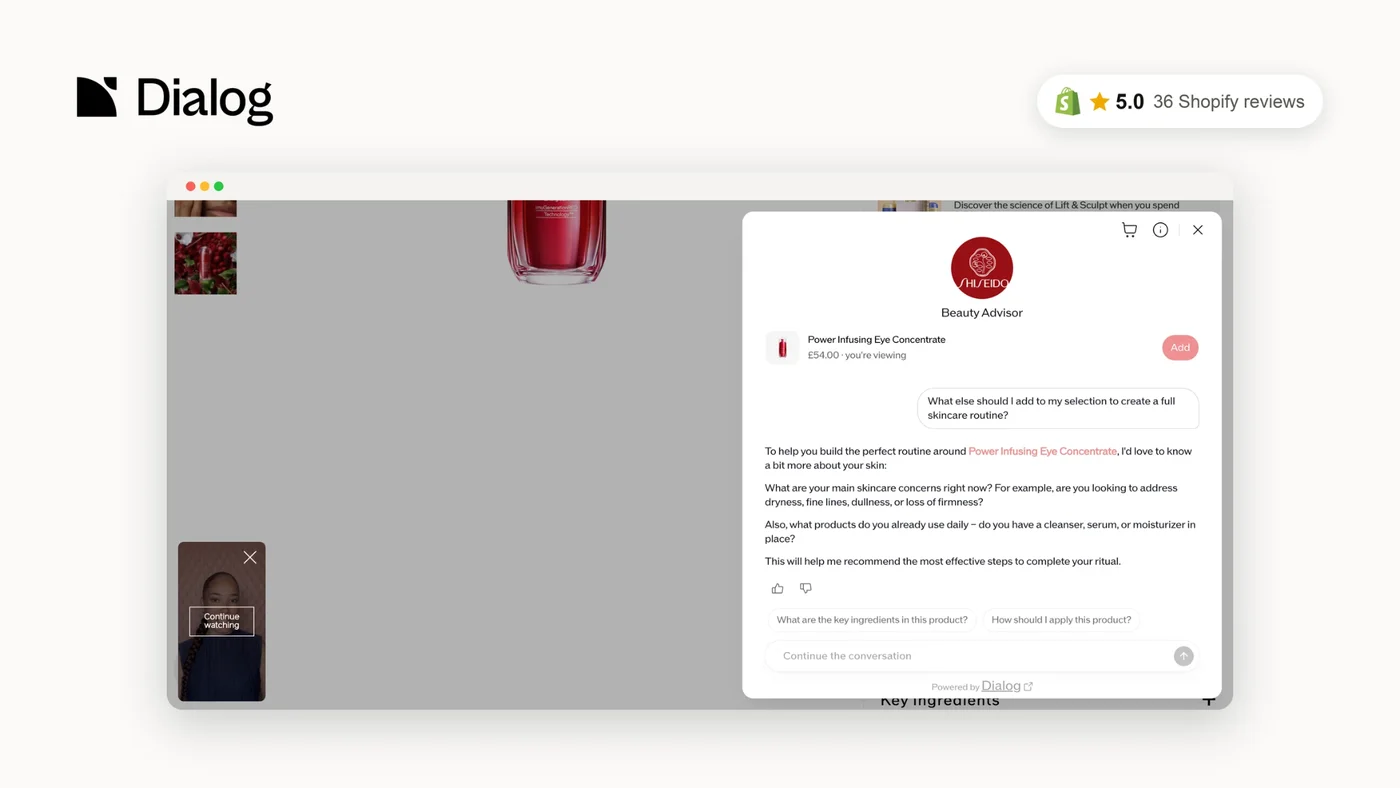
Shopify rating: 5.0/5 (36 reviews)
Dialog overview
Dialog is the pick when shoppers stall on which product to buy. It’s an AI shopping assistant that sits on the product page and in dedicated entry points like a gift finder or a skin diagnostic. Shoppers ask questions in their own words, and Dialog answers from your catalog, product pages and internal documents, then recommends the products that fit.
It works best for complex, technical or high-consideration catalogs, where a shopper needs to understand the product before buying: skincare routines, luggage sizes, cookware materials. For a store selling 30 t-shirts, it’s more than you need.
Dialog was founded in 2022. It works with brands like Shiseido, Delsey and Oh My Cream.
Dialog top features
AI PDP Assistant: answers technical questions and objections directly on the product page
AI Personal Shopper: a full conversational guide with several entry points per site (gift finder, product advisor, skin diagnostic). The AI adapts its questions to each shopper, and shoppers can keep asking after the recommendation.
Photo upload: shoppers photograph their skin, living room or a style inspiration and get matching products from the catalog
Smart Search: search that reads intent from the query, useful when shoppers don’t know a product’s name
Smart Reengagement: captures email or phone with opt-in and triggers follow-ups through Klaviyo, Brevo, Braze, Salesforce Marketing Cloud or HubSpot
Analytics and ROI: native A/B testing, conversion impact visible in GA4, and a report of the questions shoppers ask
ChatGPT Apps: the brand’s own agent inside ChatGPT, trained on the same catalog and sales logic
Channels supported: product pages, on-site search, dedicated discovery entry points, re-engagement through your email or SMS tool, and ChatGPT.
Dialog pros
Live in minutes, trained on content you already have. Merchants describe setup in clicks and training from existing documents.
“It was easy to train the AI by uploading a word document with all the Q&A’s about our brand.” Spicey, 5 stars, December 2024
It recommends from the shopper’s real constraints. Recommendations reflect what the shopper said they need, beyond what they clicked.
“Helping them choose the perfect luggage based on their travel needs and airline size restrictions.” DELSEY PARIS FRANCE, 5 stars, February 2025
Merchants report measurable lifts, some A/B tested. Thirteen of the 36 reviews mention higher conversion or add-to-cart rates.
“We ran an A/B test to validate the launch on our site. Unsurprisingly, we got excellent performance thanks to Dialog.” (translated from French) Jolly Mama, 5 stars, December 2025
It shows you what shoppers ask. The question log doubles as a to-do list for product pages and SEO.
“The bonus is being able to see what questions customers are actually asking, which gives us useful insight into where our product content might have gaps.” Odacité, 5 stars, May 2026
Dialog cons
Answers need tuning at the start. The AI works from your content, so gaps or errors in that content show up in its answers until you correct them.
“After a few tests and corrections to stop the AI passing on wrong information, we are satisfied with the results.” (translated from French) Magnifaïk, 5 stars, August 2024
Built for stores with real traffic. Paid plans start at $249/mo for 25,000 visitors, which is steep for a store doing a few thousand visits.
A focused tool. Dialog covers discovery and re-engagement on-site. Email campaigns, SMS and popups still need their own tools.
Dialog pricing
Dialog bills on monthly unique visitors, in USD every 30 days:
Plan | Monthly unique visitors | Price |
|---|---|---|
Free | 200 conversations, basic AI model | $0 |
Starter | Up to 25,000 | $249/mo |
Standard | Up to 50,000 | $399/mo |
Scale | Up to 100,000 | $799/mo |
A free trial is available, and Shopify stores can sign up without a sales call.
For our store with 50,000 monthly visitors, that’s the Standard plan at $399/mo.
Dialog video
Full disclosure: Dialog is our product, so weigh our enthusiasm accordingly. The ratings, reviews and prices above come from the Shopify App Store and our own pricing page.
3. Klaviyo: best for email recommendations
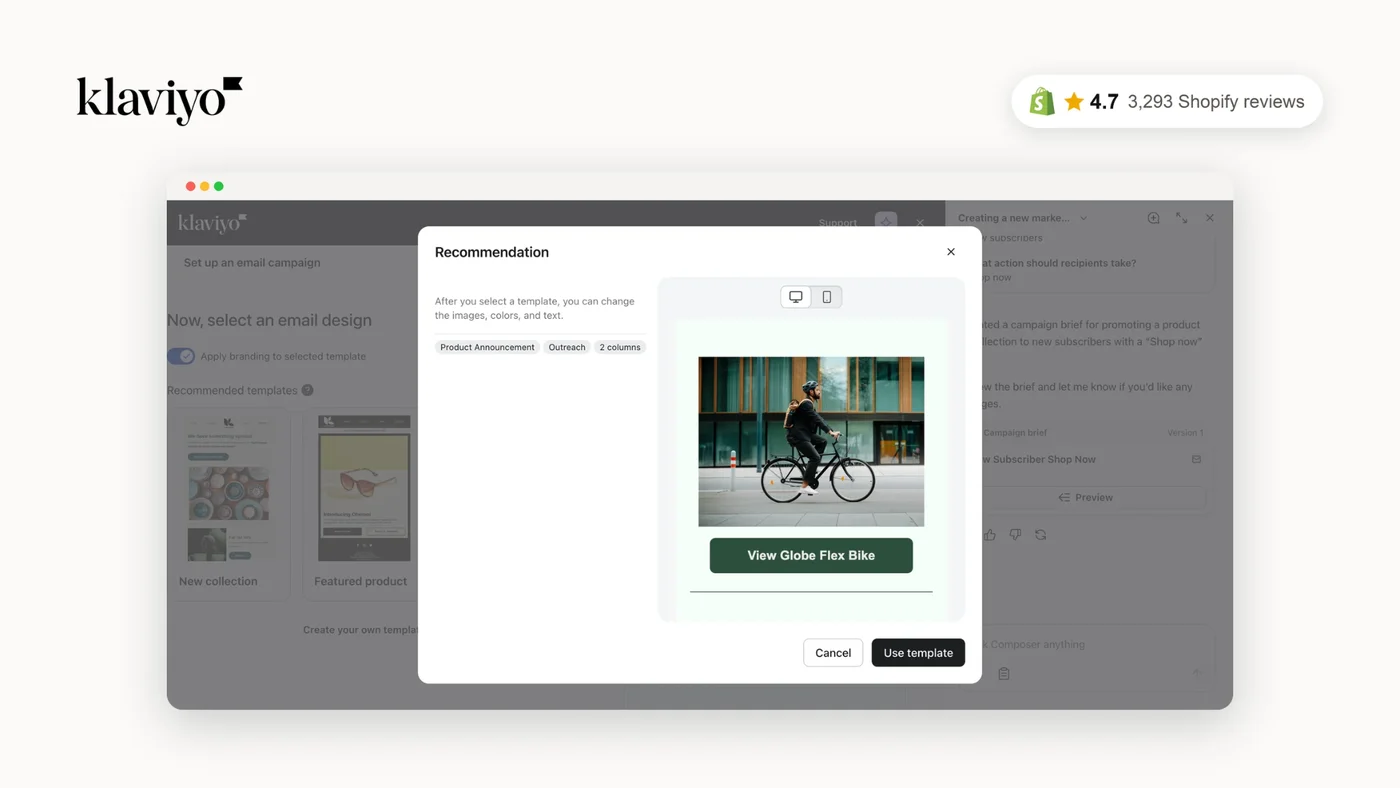
Shopify rating: 4.7/5 (3,293 reviews)
Klaviyo overview
If email already drives revenue for you, Klaviyo’s product feeds are the recommendation upgrade to make first. Most Shopify brands already use it for flows and campaigns, and product blocks drop personalized recommendations into those emails without another app.
The recommendations live in email only. Klaviyo’s product feeds work in the drag-and-drop and hybrid email editors, so they do nothing for a shopper on your product page today. They’re strongest in browse abandonment, cart abandonment, and post-purchase flows, where the email arrives with context about what the shopper looked at.
Klaviyo bills on active profiles, so its cost tracks the size of your list more than your traffic.
Klaviyo top features
Classic product feeds: best sellers (3-day or 90-day lookback), newest products and most viewed products
Personalized product feeds: recently viewed, added to cart, and “products a customer may also like”, predicted by collaborative filtering from past orders and similar customers
Fallback logic: customers with little history see classic feeds, so no email goes out with an empty block
Filters: by category, price and stock level for Shopify catalogs
Flows and segmentation: welcome, abandoned cart, browse abandonment and win-back flows with behavioral segments
Customer Agent: an AI agent that answers questions and recommends products across chat, SMS, email and WhatsApp
Channels supported: email for product feeds, plus SMS, push and WhatsApp messaging. Klaviyo says the recommendation model typically takes two days to a week to train.
Klaviyo pros
Usable without technical skills.
“As a total new comer and not a tech savvy person I found Klaviyo to be a life saver!!” Buy Wellness, 5 stars, July 2026
Deep Shopify sync. Orders, events and subscribers flow both ways, which is what personalized feeds depend on.
“The Shopify integration synced our subscribers, orders and events flawlessly, in both directions.” Super Dogs, 5 stars, July 2026
Automation that runs on its own.
“The platform is powerful, intuitive, and makes email/SMS automation feel effortless.” Phillip J Gordon Digital Art Prints, 5 stars, August 2026
Klaviyo cons
Costs climb as the list grows. Even happy merchants mention it.
“It is expensive, but it makes me money so all good!” 4MyEarth, 5 stars, August 2026
Fake and inactive profiles can inflate the bill.
“Many fake profiles are created that inflate the plan count.” Richmond Interiors Onlineshop, 1 star, July 2026
A real learning curve.
“Klaviyo takes a lot to learn but once you’ve learnt then its super easy to draft a campaign.” Lamour Artisans, 5 stars, August 2026
Klaviyo pricing
Klaviyo bills on active profiles, with SMS bought separately as credits. The free plan covers 250 active profiles, 500 emails a month and $5 of mobile messages. Paid email plans start at $20/mo for 500 profiles.
For our store with 25,000 active profiles, the Email plan costs $400/mo. The 25,001st profile moves the store to $425/mo, which is why cleaning inactive profiles is worth doing before the invoice arrives.
Klaviyo video
4. Octane AI: best for quizzes on small catalogs
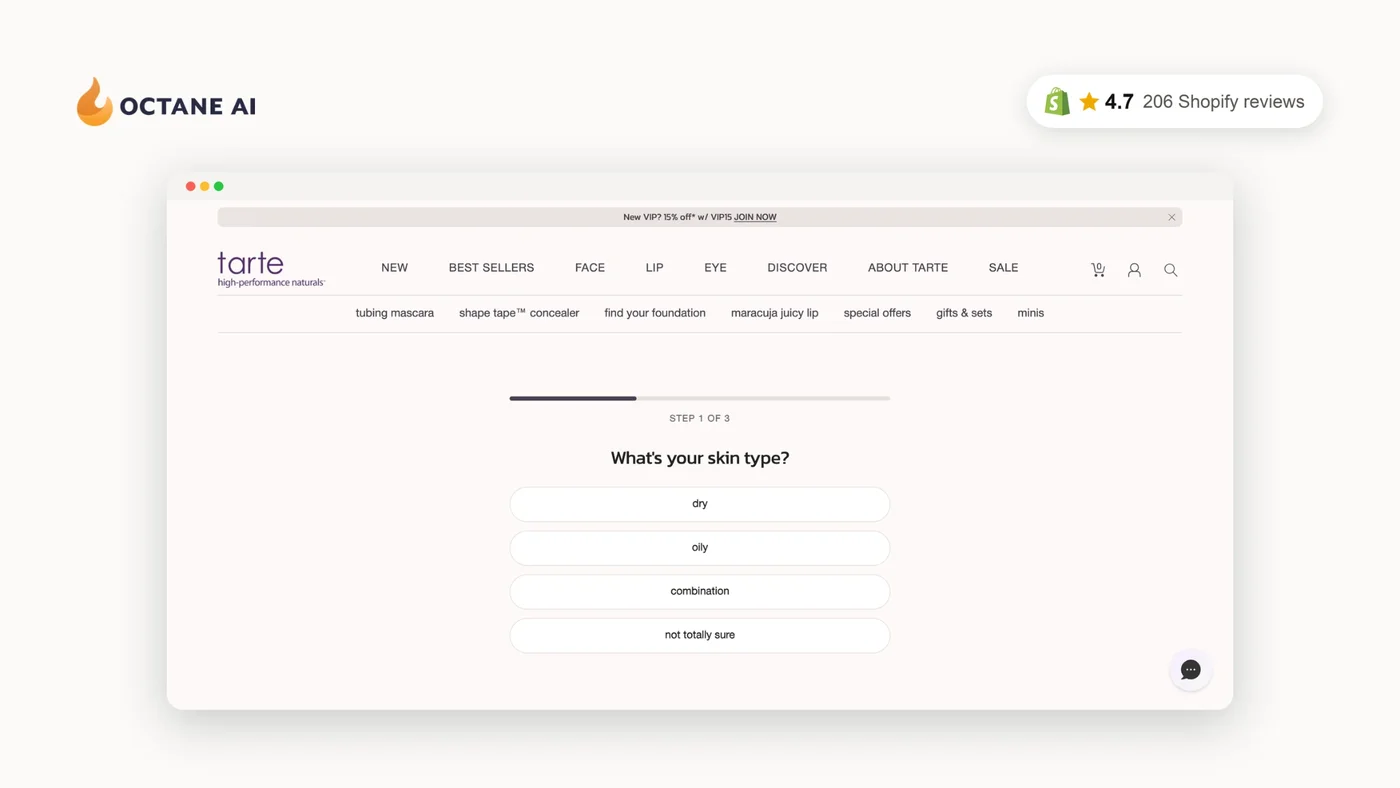
Shopify rating: 4.7/5 (206 reviews)
Octane AI overview
Octane AI is the quiz to pick when your catalog fits a short decision tree. Three to six questions (“skin type?”, “coverage?”, “budget?”) map to a handful of products, and every completed quiz adds a subscriber to Klaviyo with their answers attached.
Quizzes are the older of the two ways to ask shoppers what they need, and they still work well on small catalogs with clear criteria: skincare, supplements, coffee, pet food. The limit is the tree itself. Questions are fixed, every answer has to be mapped to products, and the conversation ends at the result page.
Octane AI top features
Quiz builder with conditional logic, templates, and custom result pages
Smart Products: AI product recommendations on quiz results
AI photo analysis: detects skin tone, undertone, hair color and more from a shopper’s photo, for beauty recommendations
Smart properties: quiz answers become variables for personalized emails, SMS and on-site copy
Pop-ups and opt-ins to launch quizzes and capture contacts
A/B testing and analytics on every plan
Integrations: Klaviyo, Attentive, Postscript, Recart, Tapcart, Gorgias
Channels supported: on-site quizzes (embedded, popup or landing page), with answers feeding email and SMS. Shopify only.
Octane AI pros
It grows the email list as it recommends.
“More opt-ins in the first 24 hours than any other form on our site!” ByHeart, 5 stars, October 2023
Merchants report it pays for itself.
“Not only has the quiz more than paid for itself, it’s brought in a nice additional chunk of revenue for us.” P. F. Candle Co., 5 stars, July 2024
Deep customization and integrations.
“A very complete platform with strong customization options and integrations, which has helped us create more tailored quiz experiences.” Neuro, 5 stars, April 2026
Hands-on support that helps design the quiz.
“He took my quiz, provided suggestions, and offered a white glove experience.” Couch.com, 5 stars, May 2025
Octane AI cons
Product mapping gets heavy on large catalogs. Answers are matched to products by hand, which merchants with big catalogs find impractical.
“We intended to use their pop-up quiz but found it would take way too long to set up for stores like ours with 1000+ products.” Cheap Rugs Australia, 3 stars, August 2021
The builder can feel clunky.
“The app/tech itself is a little clunky.” Dog Proofer, 3 stars, February 2025
AI output needs checking.
“It was providing inaccurate product descriptions for the products it was recommending.” ThatsSmoooth, 3 stars, June 2023
Octane AI pricing
Octane bills on credits. One credit is one completed quiz, and AI features add fractions: about 0.3 credits for Smart Products, 0.1 for Smart Copy and 0.2 for image analysis.
Plan | Credits included | Quizzes | Monthly price |
|---|---|---|---|
Basic | 400 | 2 | $50 |
Plus | 2,200 | Unlimited | $200 |
Enterprise | 7,250+ or unlimited | Unlimited | $500+ |
Annual billing saves 15%, unused credits roll over for 30 days, and extra credits cost $0.10 each at the end of the cycle. The quiz keeps running when you go over. There’s a 14-day free trial.
For our store, 1,000 quiz completions with AI recommendations use about 1,300 credits a month. On Basic, that’s $50 plus 900 extra credits at $0.10, so $140/mo. Plus costs $200/mo and leaves 900 credits of headroom. Basic with overage stays cheaper until about 1,900 credits a month, so the real reason to upgrade is the two-quiz limit.
5. Wisepops: best for popup recommendations
Shopify rating: 4.9/5 (70 reviews)
Wisepops overview
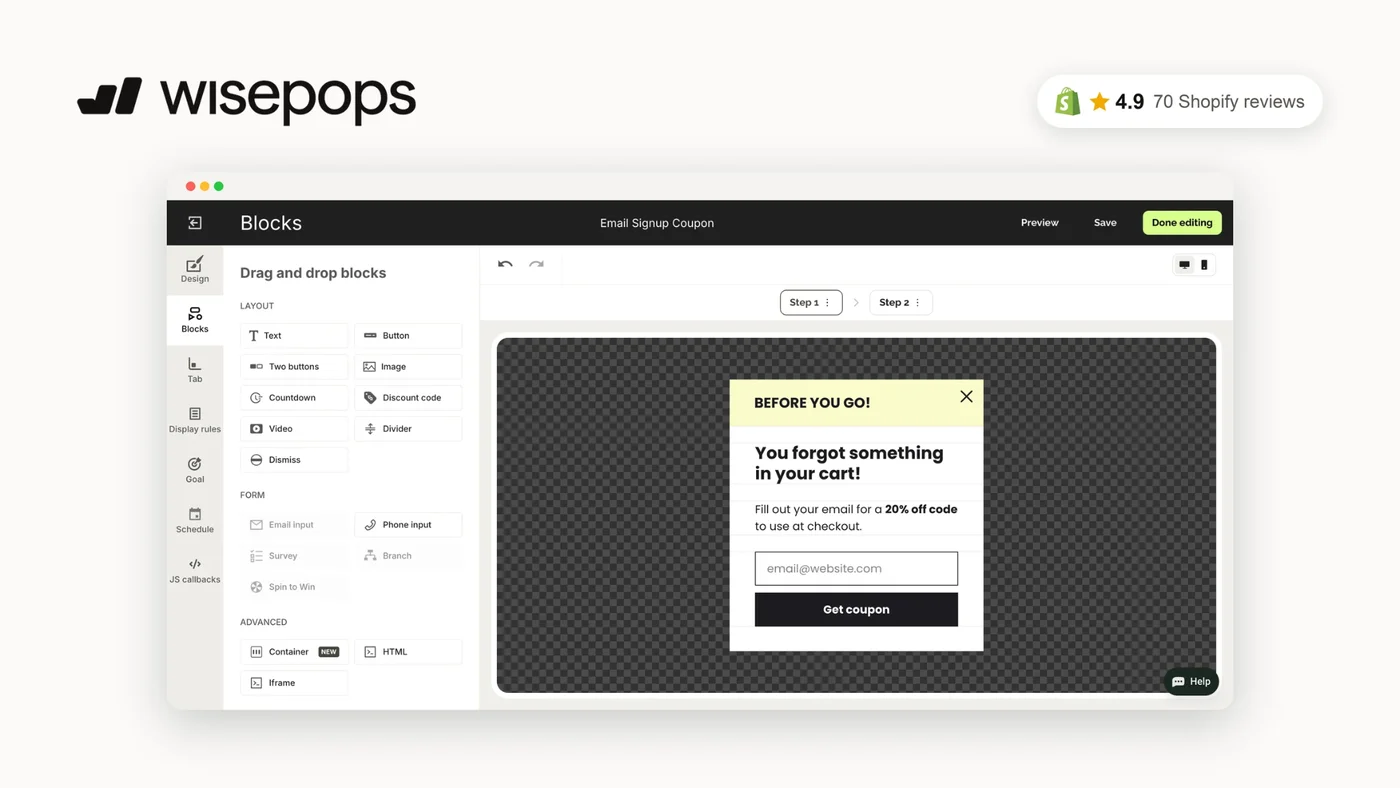
Wisepops fits brands that already treat popups as a sales channel and want product recommendations inside them. It started as a popup builder and now covers popups, embedded blocks, an on-site notification feed and web push, with targeting precise enough to show different offers to first-time visitors, returning customers or high-value carts.
Its AI product recommendations add six strategies to those formats, from best sellers to “frequently bought together”. They’re Shopify-only and require the Essential plan.
Pricing starts at €499/mo after a demo, which puts it in mid-market territory.
Wisepops top features
Six recommendation strategies: best sellers (90 days), trending (7 days), others also viewed, personalized picks, recently viewed and frequently bought together
Formats: popups, embedded blocks and the on-site notification feed (recommendations don’t run in web push)
Targeting: visit count, cart value, logged-in status, UTM, geolocation, device and more
Stock and inclusion rules: campaigns only show when enough eligible products remain
Lead capture: email and SMS forms, surveys, with Klaviyo and other email integrations
A/B testing and analytics, with revenue attributed to clicked products only
Channels supported: on-site popups, embeds and feed, plus web push for non-recommendation campaigns. Recommendations require Shopify.
Wisepops pros
Precise targeting. This is the most repeated praise in recent reviews.
“The targeting and triggering rules are incredibly precise.” Kenneth Cole Europe, 5 stars, February 2026
Personalized product pushes.
“Easy to use and very effective, for informational messages as well as personalized product pushes.” (translated from French) OHLALA, 5 stars, March 2026
Quick to install without a developer.
“Pretty much a plug and play app, easy set-up and speedy.” Grenade UK, 5 stars, July 2025
Wisepops cons
Billed on every pageview. Merchants complain that the price follows total site traffic, whether or not a popup appears.
“One customer going through 10 pages at once is 10 pageviews.” International Beauty Services & Supplies, 3 stars, November 2023
Advanced features cost more. Recommendations sit on the Essential plan.
Only 5 of 70 reviews give fewer than five stars, and most of the pricing complaints are several years old.
Wisepops pricing
Wisepops doesn’t publish plan tiers. Its pricing page says plans start at €499/mo, with a managed offer (strategy, tech and execution) from €599/mo, and that price “depends on your traffic volume, channels, and level of service”. You get a quote after a demo or audit.
Billing follows page views. For our 50,000-visitor store, the cost can’t be worked out without a quote, and product recommendations require the Essential plan. Budget at least €499/mo before asking.
Wisepops video
6. InsiderOne: best all-in-one suite
Shopify rating: 4.6/5 (18 reviews)
InsiderOne overview
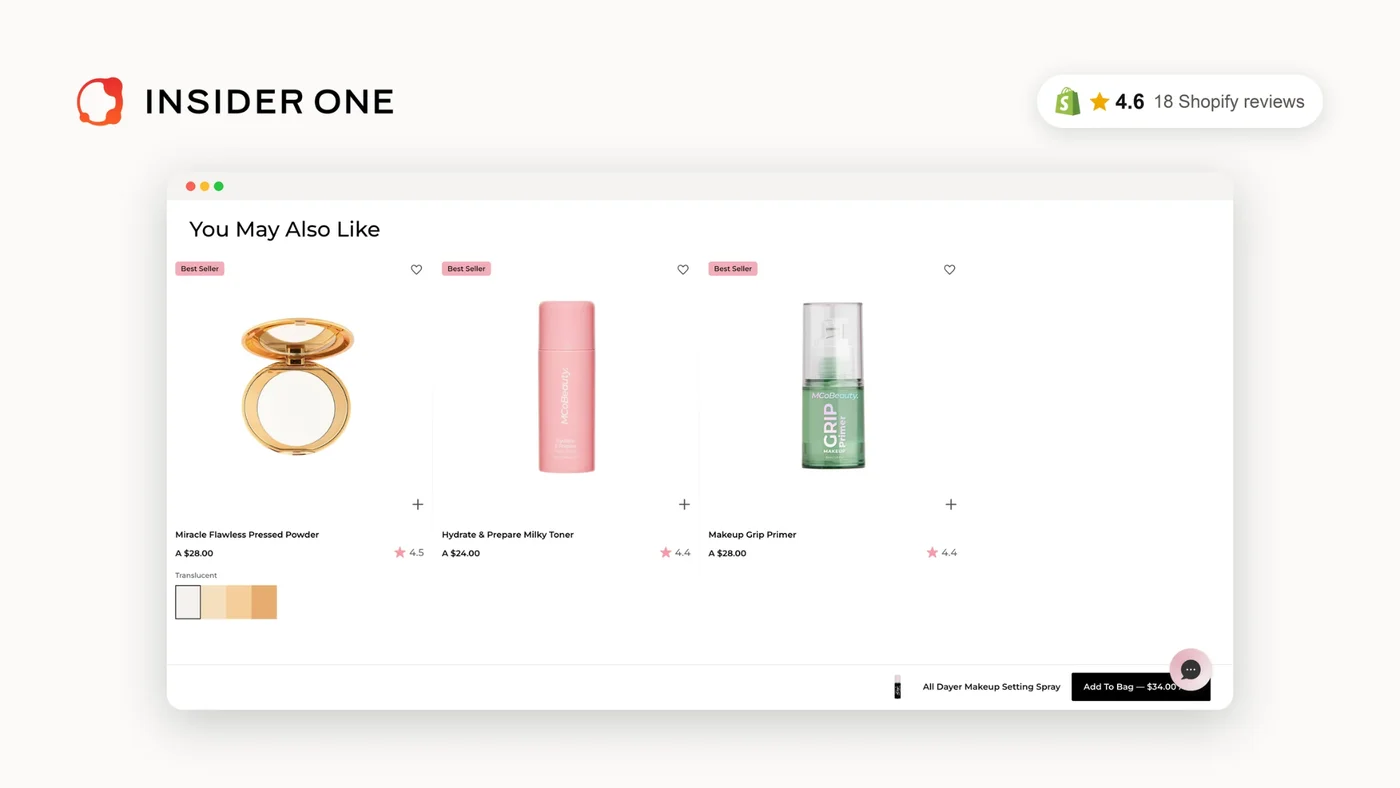
InsiderOne makes sense when you want one vendor for customer data, email, SMS, WhatsApp, on-site personalization, and recommendations. It’s built for enterprise teams consolidating martech, with customers like Samsung, Estée Lauder and Gap. You buy the suite, and recommendations come with it.
Recommendations are one module among many. InsiderOne offers 20+ strategies (bought together, user-based, most valuable products) and chooses the best one for each slot from product attributes and shopper affinity. In May 2026 it added Agent One, a set of shopping, support, and insights agents.
The trade-off is weight: no public pricing, no trial, and a platform that takes onboarding time.
InsiderOne top features
Customer data platform: one profile per shopper across web, app, email and messaging
Smart Recommender: 20+ recommendation strategies, auto-optimized per slot
AI site search and on-site personalization templates
Architect: a journey builder for automated, cross-channel campaigns
Messaging: email, SMS, WhatsApp, web push and in-app
Agent One: shopping, support and insights AI agents
Channels supported: on-site, app, email, SMS, WhatsApp, web push and in-app.
InsiderOne pros
Fast Shopify integration.
“Integration is a breeze, requiring no developer support.” Pattern Beauty, 5 stars, March 2024
Recommendations that grow the basket. Only one review mentions them directly, but it’s specific.
“Smart recommender that helps us to increase basket size.” iStudio Online Store, 5 stars, July 2024
Every channel in one platform.
“We managed to integrate all the channels in one platform that centralizes every event/interaction with the digital assets of our brand.” MAGIA NATURAL, 5 stars, October 2025
Dedicated and local support.
“We also get dedicated support from CSM & OXT teams.” MAGIA NATURAL, 5 stars, October 2025
InsiderOne cons
Data integration can drag on at high volume.
“We spent months discussing Shopify API limitations in sending data, when that’s the kind of problem for whoever develops the app, not the customer.” (translated from Portuguese) Havaianas Brasil, 2 stars, January 2026
A learning curve on setup and campaigns.
“Installation, certificates and the first designs aren’t very user-friendly. It does take us effort to finish processes and learn campaigns and tools.” (translated from Spanish) Wilson, 4 stars, March 2024
You can’t buy recommendations alone. The recommendation engine is bundled into the suite.
InsiderOne pricing
InsiderOne doesn’t publish pricing. There’s no free trial and no self-serve plan; you buy through sales, and the recommendation engine comes bundled with the suite. For our 50,000-visitor store there’s nothing to calculate, and that is the answer: if you only need recommendations, you’ll be paying for a platform built for much more.
InsiderOne video
How to choose and when to stack
Five of these six apps bill on a different unit: orders, visitors, profiles, quiz credits and pageviews. That makes headline prices hard to compare, and it’s why the choice should start from the problem you’re fixing.
Four questions sort most stores:
How broad is your catalog? A few dozen products with clear criteria suit a quiz like Octane AI. Hundreds of products with technical differences suit a conversational tool like Dialog. Large catalogs with frequent add-on purchases suit widgets like Wiser AI.
What’s your top challenge? Low order value points to Wiser AI. Shoppers who browse and leave without choosing point to Dialog. Weak repeat purchases point to Klaviyo.
What’s your budget? Wiser AI starts at $9/mo. Klaviyo and Octane AI start at $20 and $50. Dialog starts at $249, Wisepops at €499, and InsiderOne sells through quotes.
How big is your email list? A list of tens of thousands makes Klaviyo’s product feeds worth the setup. A small list makes Octane’s opt-ins more valuable than email recommendations.
Stacking works, and the math adds up fast. For our store, Wiser AI ($99), Dialog ($399), Klaviyo ($400) and Octane AI ($140) come to about $1,038/mo before Wisepops, which needs a quote. Each one is reasonable alone. Together, they’re four invoices that move with four different numbers.
That’s where a suite like InsiderOne starts to make sense: when you’re already running four or more channels and have a team to operate one platform. Most stores should buy the tool for their biggest problem first, then add the next one when that channel proves itself.
Conclusion
Shopify’s free recommendations are a starting point, and most growing stores outgrow them quickly. The right upgrade depends on which sales you’re missing.
Start with Wiser AI if you want bigger orders. It adds widgets across the store for $99/mo at 1,000 orders, with checkout upsells on Enterprise.
Pick Dialog if shoppers can’t decide. It answers questions and recommends in conversation, on a traffic-based price ($399/mo at 50,000 visitors).
Use Klaviyo’s product feeds if email already drives revenue. Expect about $400/mo at 25,000 profiles, and keep the list clean.
Choose Octane AI for a small catalog with clear criteria. $140 to $200/mo at 1,000 quiz completions, plus a growing email list.
Add Wisepops if popups are already a lever. Budget from €499/mo, quote only.
Consider InsiderOne only when consolidating many channels. You buy the whole suite.
Whatever you pick, test it. Wiser AI, Dialog and Octane AI all offer A/B testing, which tells you whether the recommendations drive sales or only get credit for them.
