


GEO tools for ecommerce measure whether your products are cited, compared and recommended by ChatGPT, Gemini, Google AI Overviews, Claude, Copilot or Perplexity, then tell you what to fix. We compared eight of them: a product tracking specialist, three SEO suites that have added an AI module, a diagnostic tool, two free official sources and a feed manager that sends your catalog to ChatGPT. For a brand that sells online, the right setup comes down to three building blocks: a measurement tool, the free reports from Google and Microsoft, and a clean product feed.
Comparison carried out in October 2026. Pricing and features were checked on each vendor’s website at that date.
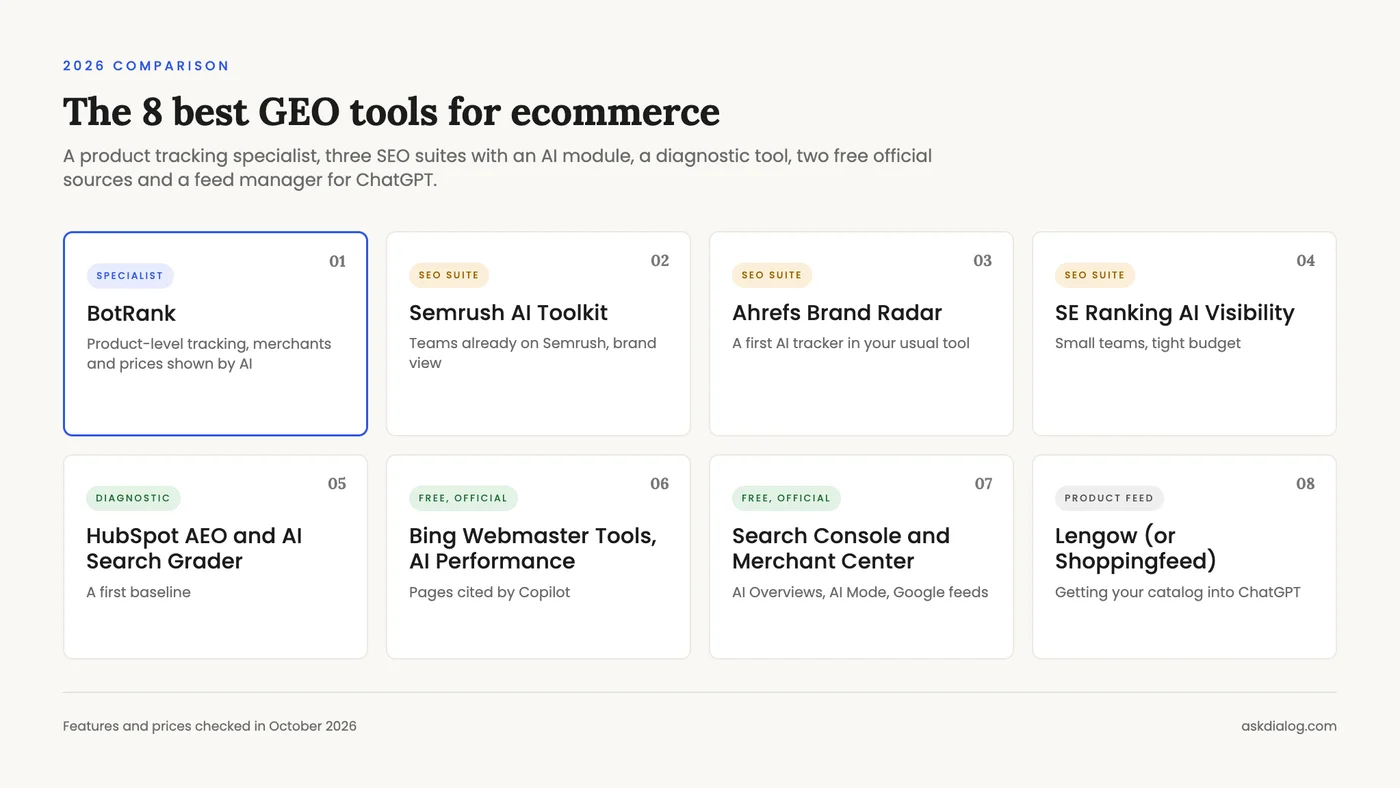
TL;DR: which GEO tool to choose for your store
You want to track your products, not just your brand: BotRank is the only tool on this list that measures the presence, win rate and rank of each product in AI shopping answers, along with the merchants and prices displayed.
You already pay for Semrush or Ahrefs: turn on their AI module for brand-level tracking, knowing that product tracking either does not exist there or is reserved for Enterprise plans.
You have no budget: start with the AI Performance report in Bing Webmaster Tools, Google Search Console and Merchant Center, then HubSpot’s free diagnostic.
You want your products to show up in ChatGPT Shopping: use a feed manager such as Lengow or Shoppingfeed to supply OpenAI’s merchant portal.
You want to convert visitors who arrive from an AI: measurement is not enough, you need a shopping agent on your site that picks up the conversation where the AI left off.
Tool | Best for | Product-level tracking | Engines tracked | Starting price |
|---|---|---|---|---|
BotRank | Ecommerce brands that want to know what to fix | Yes | ChatGPT, Gemini, Google AI Overviews and AI Mode, Copilot, Perplexity, Claude, Mistral, Grok (3 of your choice per plan) | €89 per month |
Semrush AI Toolkit | Teams already using Semrush | Enterprise only | Major AI engines | $99 per month |
Ahrefs Brand Radar | SEO teams that want a first AI tracker | No | Google AI Overviews and AI Mode, ChatGPT, Perplexity, Gemini, Copilot | Index from $199 per month, prompts from $50 per month |
SE Ranking AI Visibility | Small teams on a tight budget | No | ChatGPT, Perplexity, Gemini, Google AI Mode and AI Overviews | With a subscription, free trial |
HubSpot AEO and AI Search Grader | A first diagnostic, HubSpot teams | No | ChatGPT, Perplexity, Gemini | Free grader, AEO €49 per month |
Bing Webmaster Tools, AI Performance report | Knowing which pages Copilot cites | No (per page) | Copilot and Bing AI answers | Free |
Google Search Console and Merchant Center | AI Overviews, AI Mode, Google product feeds | Per product in Merchant Center | Free | |
Lengow (or Shoppingfeed) | Getting your catalog into ChatGPT | Yes (feed) | ChatGPT Shopping | On quote |
What is a GEO tool for ecommerce?
A GEO tool for ecommerce is software that measures how often a brand’s products appear in the answers of AI engines, identifies the merchants and sources those engines cite, and recommends actions to improve that presence.
GEO stands for Generative Engine Optimization: optimizing visibility in generative answer engines, as opposed to SEO, which targets classic search results pages.
How it differs from a general-purpose GEO tool
A general-purpose GEO tool answers the question “is my brand cited?”. For a brand that sells products, that question falls short. When a shopper asks ChatGPT “which carry-on suitcase should I buy for under $200”, the answer does not cite a brand: it shows specific products, with a price, a merchant and sometimes a buy button. Three things change compared with tracking a brand:
The unit of measurement. You track product SKUs, not a name. A brand can be highly visible on its hero products and absent from the rest of its catalog.
The role of merchants. AI engines choose who sells the product: your site, a retailer, a marketplace, a second-hand reseller. A brand can be recommended without getting the sale.
Product data. Catalog feeds, structured data, prices and availability carry as much weight as editorial content, because AI engines read product pages and feeds before they answer.
What an ecommerce GEO tool should measure
Six metrics let you manage a catalog’s visibility in AI engines:
Presence per product: the share of relevant shopping answers in which the product appears.
Rank: the product’s position in the selection or carousel displayed.
Merchant share: who is named as the seller, and in what proportion.
Price consistency: does the price shown by the AI match the real price?
Cited sources: marketplaces, comparison sites, reviews, brand sites, media.
Attributes and sentiment: how the AI describes the product, and whether that description is accurate.
A tool that covers only the first metric tells you that you exist. A tool that covers all six tells you what to do.
What does AI shopping look like in 2026?
Today, AI shopping works in two steps: discovery inside the AI, then the purchase on the site. So you need two things: measure how exposed your offer is, which is the job of the GEO tools on this list, then convert the visitor who lands on your site with a recommendation in mind. That is where an AI shopping agent on your site comes in, picking up the conversation where ChatGPT or Gemini left off, with your product data and your brand expertise.
How we selected these GEO tools
We used six criteria, in this order of importance for a brand that sells online:
Product-level tracking, not just brand-level.
Engines covered: ChatGPT, Gemini, Google AI Overviews and AI Mode, Claude, Copilot, Perplexity.
Merchants and prices: does the tool show who sells, and at what price, in the answers?
Concrete actions: does the tool tell you what to fix, or does it only measure?
International coverage: interface, markets and languages covered.
Pricing for a mid-sized brand: a plan you can buy without going through an Enterprise negotiation.
Features and prices were checked on vendors’ websites in October 2026. Figures reported by vendors are presented as such.
Other AI visibility tracking tools exist; this selection favors a product tracking specialist, the suites many teams already own, the free official sources and the catalog distribution layer, because that is the combination an ecommerce brand needs.
BotRank: best for ecommerce brands that want to track their products and know what to fix
What is BotRank?
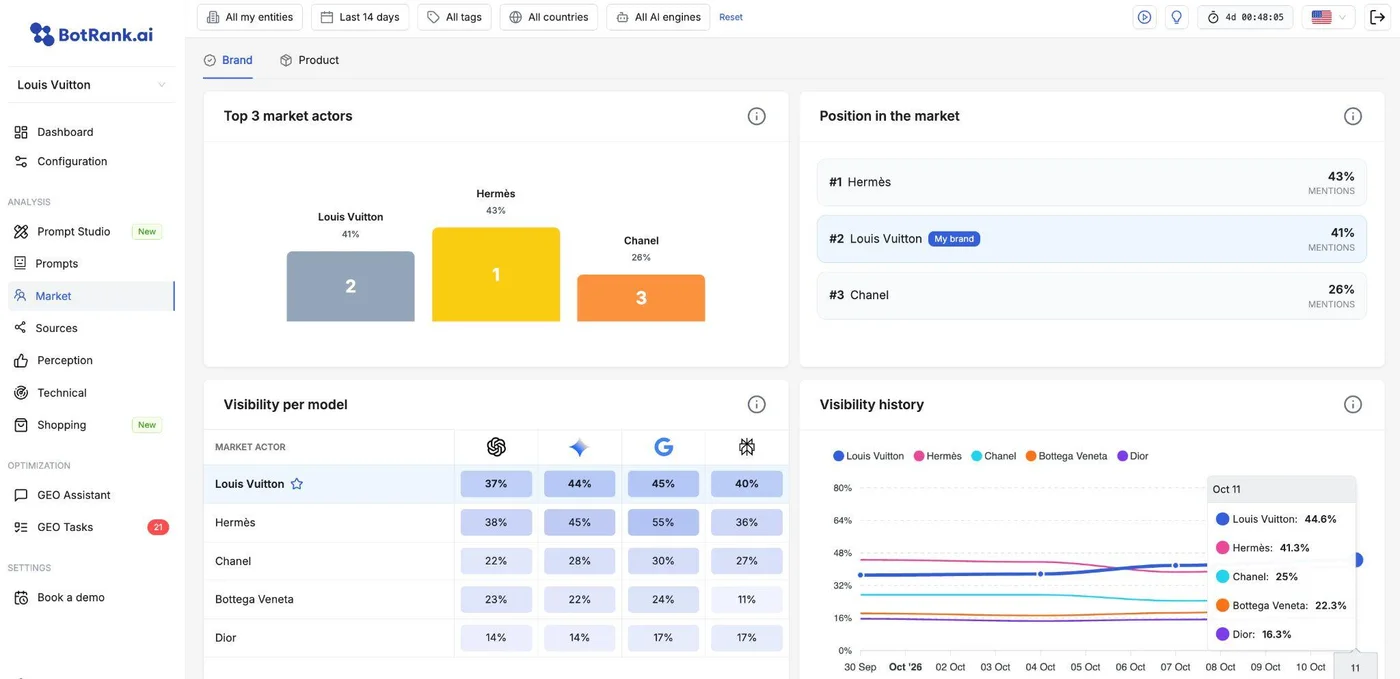
BotRank is a GEO platform that measures and improves the visibility of a brand and its products in ChatGPT, Gemini, Google AI Overviews and AI Mode, Claude, Copilot, Perplexity, Mistral and Grok. It is used by brands such as Philips, Boiron, Ferrero, Sarenza and GRDF. It stands out with a commerce-specific feature, AI Shopping, which tracks products instead of just tracking the brand.
What it brings an ecommerce brand
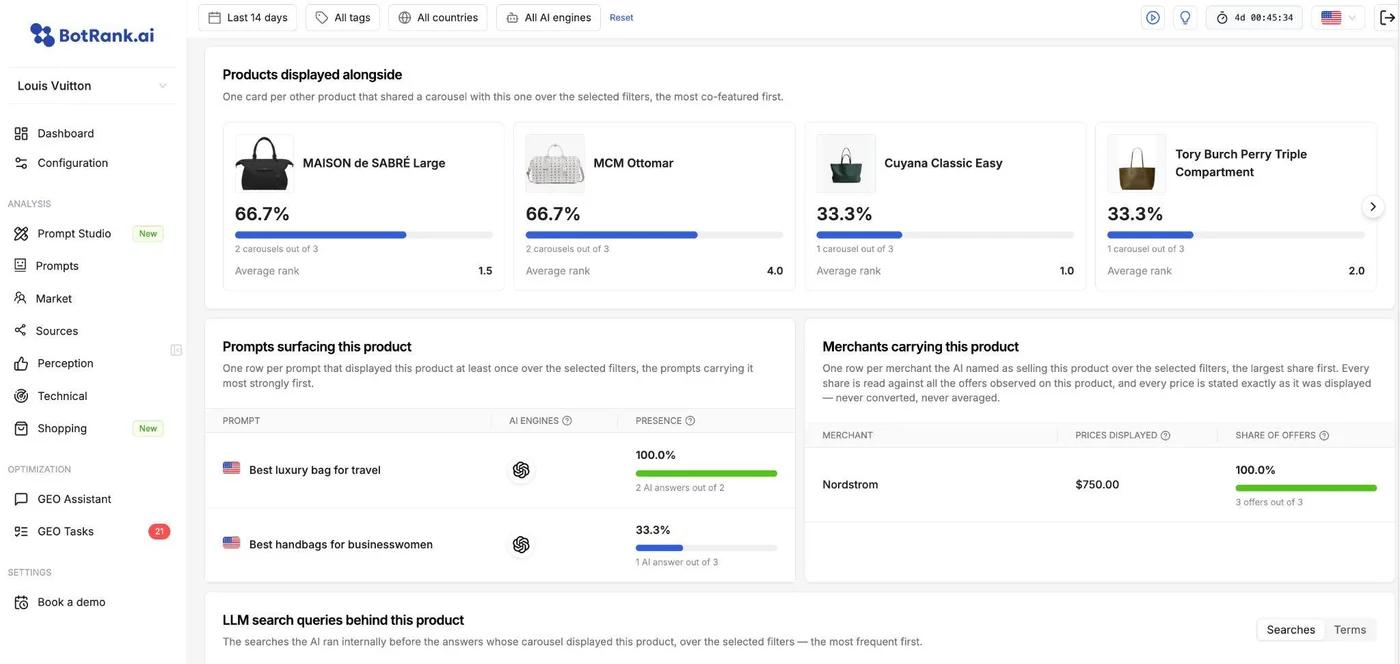
Product-level tracking: for each SKU, the presence, win rate and average rank in the shopping carousels and selections displayed by ChatGPT, Gemini and Perplexity. The brand’s products are distinguished from competitors’ products shown alongside them.
Merchants and prices: for a given SKU, the sellers named by the AI, their share of the offers observed and the prices as displayed. You can see whether the brand’s site, a retailer, a marketplace or a second-hand reseller captures the visibility.
The prompts that trigger a product’s appearance, along with the products recommended next to it, which reveals the comparisons that weigh on the purchase decision.
Recommendations: which product pages, category pages, comparisons and buying guides to optimize first, and which catalog feed, product data or price and availability consistency issues to fix.
Source analysis: BotRank publishes research on the sites AI engines cite, including a study of more than one million AI answers (in French), useful for deciding where to focus content and PR efforts.
Limitations
Product tracking covers ChatGPT, Gemini and Perplexity; for Google AI Overviews and AI Mode, tracking happens at brand and citation level.
The Starter and Business plans cover three engines of your choice; tracking every engine requires the Custom plan.
BotRank measures and recommends, but it does not distribute your catalog or handle payment: it works alongside a feed manager.
Pricing and availability
Starter at €89 per month (25 prompts, 3 engines of your choice, all countries and languages, unlimited users), Business at €289 per month (100 prompts, technical scan of 25 pages), Custom on quote with every engine plus API and MCP access. 7-day free trial on all plans, 15% off with annual billing. French company, interface available in English and French.
Semrush AI Toolkit: best for teams already using Semrush
What is the Semrush AI Toolkit?
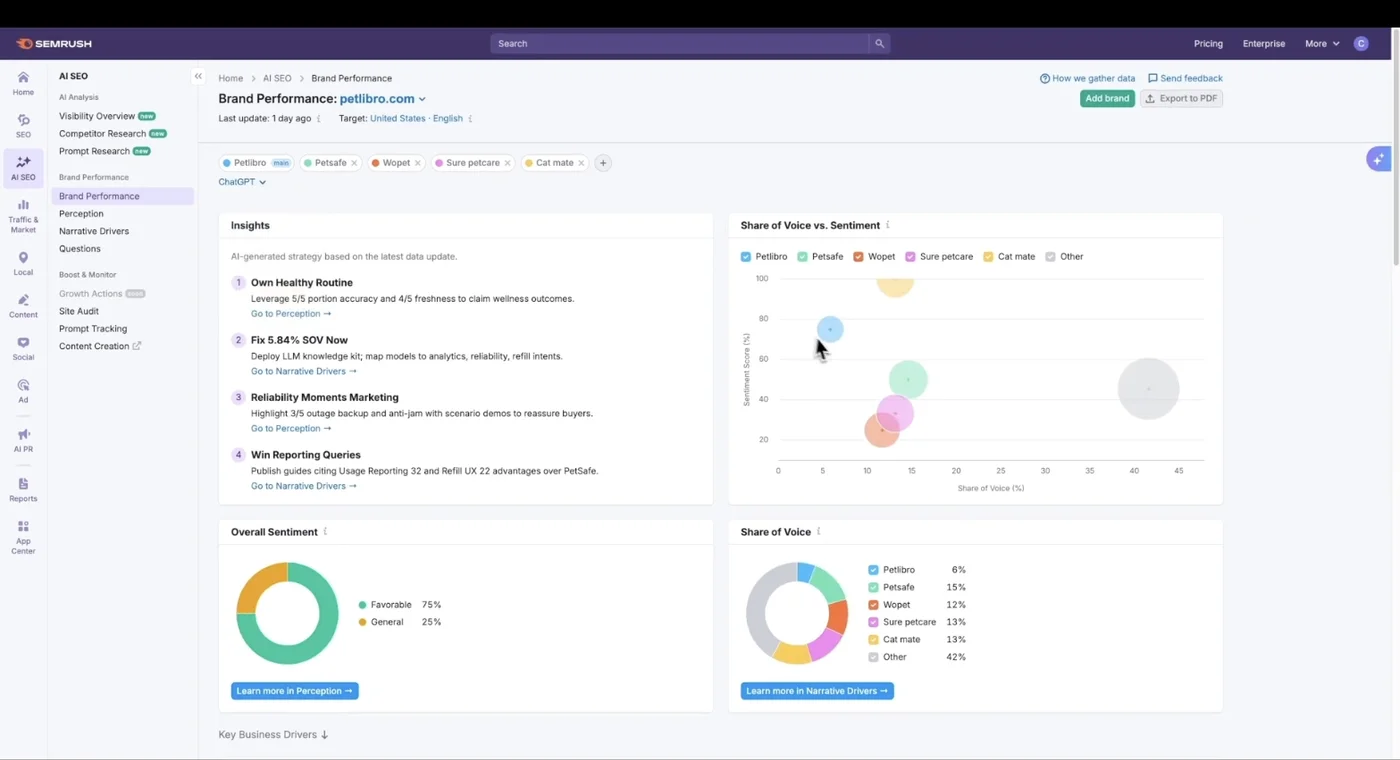
The Semrush AI Toolkit is the AI visibility module of the Semrush SEO suite. It measures a brand’s mentions in the answers of the major AI engines, its share of voice against competitors and the sentiment of the answers, inside the environment SEO teams already know.
What it brings an ecommerce brand
Brand tracking in AI answers, with a comparison against competitors.
An analysis of cited sources and of the topics where the brand is present or absent.
Integration with Semrush’s classic SEO data, handy for a team that manages both channels in one place.
Limitations
Tracking of products, prices and performance in shopping results is reserved for the Enterprise AIO plan, on quote, according to Toolradar’s review of October 4, 2026. The $99 per month toolkit works at brand level.
No view of the merchants capturing the sale.
Pricing and availability
Toolkit at $99 per month on top of the Semrush subscription, Enterprise AIO on quote. Interface available in several languages.
Ahrefs Brand Radar: best for SEO teams that want a first AI tracker in their usual tool
What is Ahrefs Brand Radar?
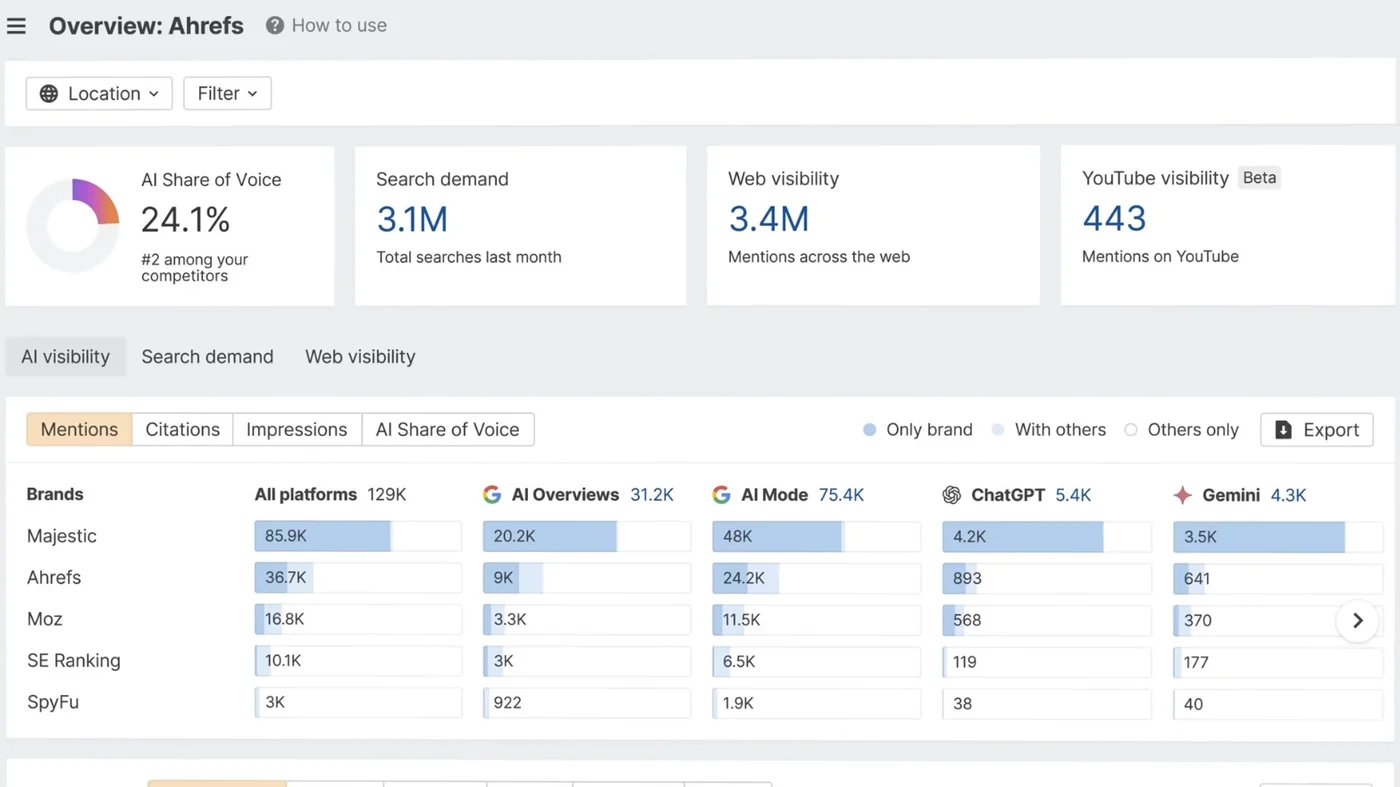
Brand Radar is Ahrefs’ AI visibility module. It includes an AI visibility index, which lets you search any brand, product or category across a corpus of answers already collected, plus custom prompts tracked daily.
What it brings an ecommerce brand
The index covers Google AI Overviews and AI Mode, ChatGPT, Perplexity, Gemini and Copilot; custom prompts add Claude.
A quota of custom prompts is included in paid Ahrefs plans: 5 per day on Lite, 10 on Standard, 20 on Advanced.
The category view shows which brands dominate a product family in AI answers.
Limitations
No product-level tracking, no data on merchants or on displayed prices.
Beyond the included quota, custom prompts start at $50 per month and the index at $199 per month, with overage billing.
Pricing and availability
Index from $199 per month, custom prompts from $50 per month, on top of an Ahrefs subscription. Interface in English.
SE Ranking AI Visibility: best for small teams on a tight budget
What is SE Ranking AI Visibility?
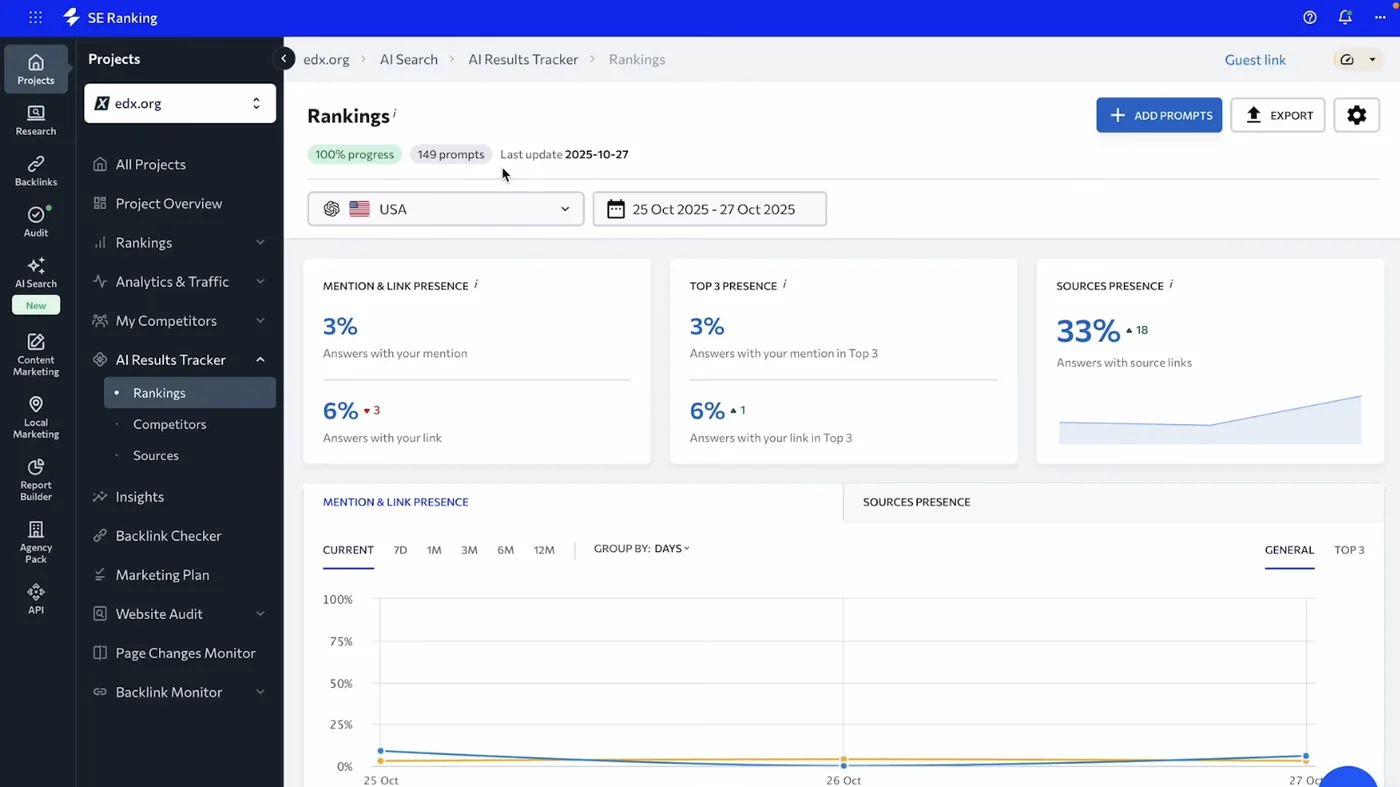
SE Ranking is an entry-level SEO suite that has added AI visibility tracking. The tool tracks the mentions and links triggered by your prompts, with their position in the answers, on ChatGPT, Perplexity, Gemini, Google AI Mode and AI Overviews.
What it brings an ecommerce brand
An aggregate AI visibility score, based on mention ranking and citation frequency.
An analysis of cited sources, sorted by type (media, blogs, forums), useful for spotting the comparison and review sites to work on.
Cached copies of AI answers and a history, to document changes over time.
A free checker, limited to 5 checks per day, for a first look.
Limitations
No tracking of products or shopping results.
Results are viewed in the interface, with no API dedicated to AI tracking.
The module’s pricing is not shown on the product page; it depends on the SE Ranking plan you choose.
Pricing and availability
Included in SE Ranking plans depending on subscription level, free trial with no credit card. Interface available in several languages.
HubSpot AEO and AI Search Grader: best for a first diagnostic and HubSpot teams
What is HubSpot AEO?
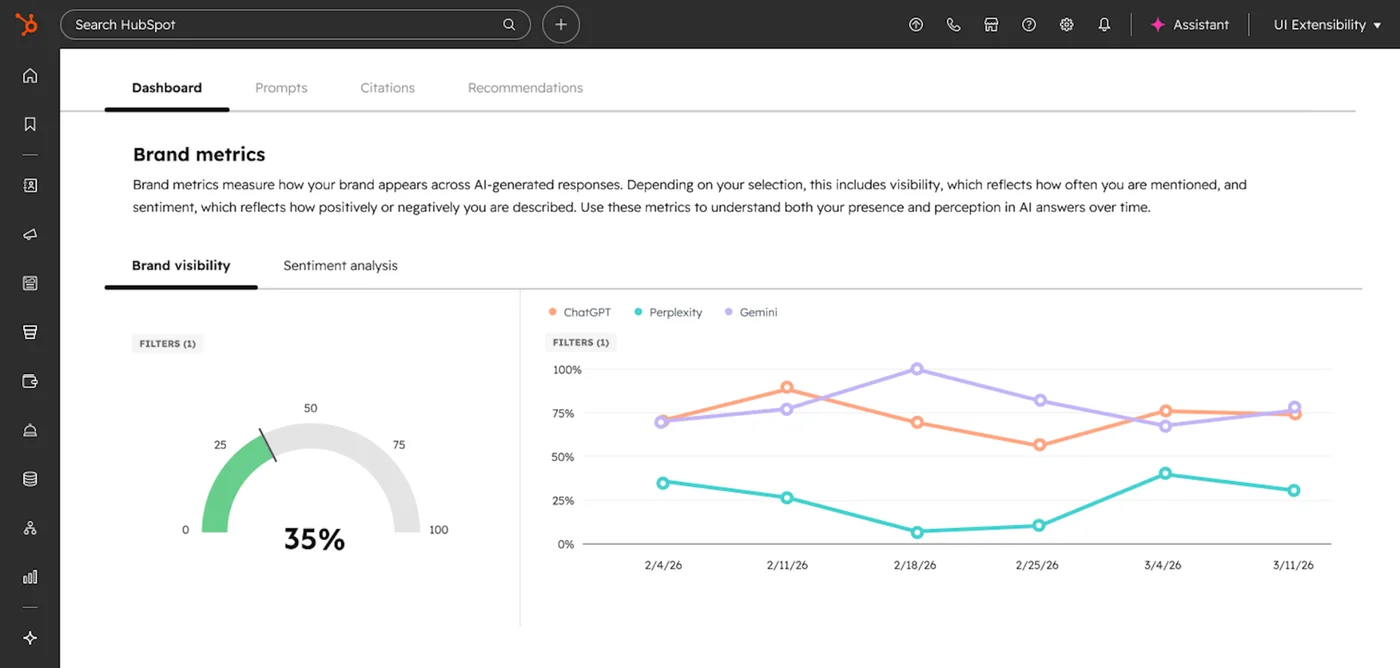
HubSpot AEO is HubSpot’s AI visibility module, in beta, paired with a free one-off diagnostic tool, the AI Search Grader. The module tracks your prompts daily on ChatGPT, Perplexity and Gemini.
What it brings an ecommerce brand
A free diagnostic in a few minutes with the AI Search Grader, no subscription needed, to find out whether the brand is absent or already cited.
In the paid module: brand visibility (share of prompts whose answer mentions the brand), sentiment, share of voice against competitors and the most cited domains in the category.
Prioritized recommendations, plus prompt suggestions drawn from the CRM for Marketing Hub Pro or Enterprise customers.
Limitations
No product tracking, no merchants or prices.
25 prompts across 3 engines in the base plan, €20 per month for each pack of 10 extra prompts.
The citation rate benchmarks shown on the page are given without a specific source.
Pricing and availability
AI Search Grader is free. AEO module at €49 per month after a 28-day trial, no HubSpot subscription required. Interface available in several languages.
Bing Webmaster Tools, AI Performance report: best for knowing which pages Copilot cites
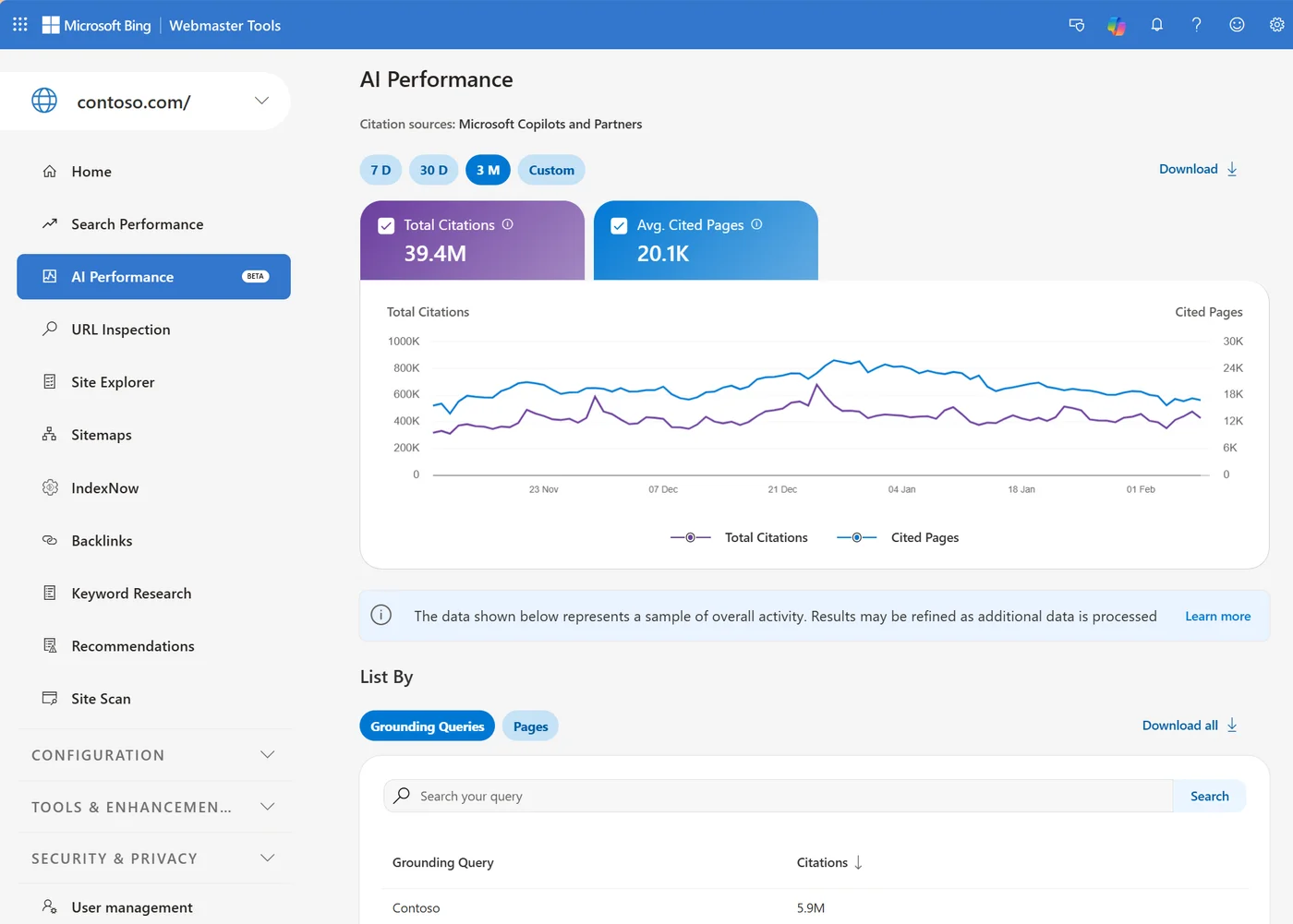
What is the AI Performance report?
The AI Performance report is a section of Bing Webmaster Tools launched in public beta on February 10, 2026. It shows where and how often your pages are cited in the AI answers of Bing and Microsoft Copilot.
What it brings an ecommerce brand
Official, free, page-level data: AI impressions, clicks to the site, cited pages, grounding queries and trends over time.
The only source that tells you, without estimates, which product pages, guides or comparisons on your site feed Copilot’s answers.
A way to check that work on product pages or buying guides translates into citations.
Limitations
Limited to the Microsoft ecosystem: nothing on ChatGPT, Gemini or Perplexity.
No rank, no prominence, no competitive view and no merchants.
The data covers your pages, not your products as such.
Pricing and availability
Free for any site verified in Bing Webmaster Tools, available worldwide.
Google Search Console and Merchant Center: best for AI Overviews, AI Mode and Google product feeds
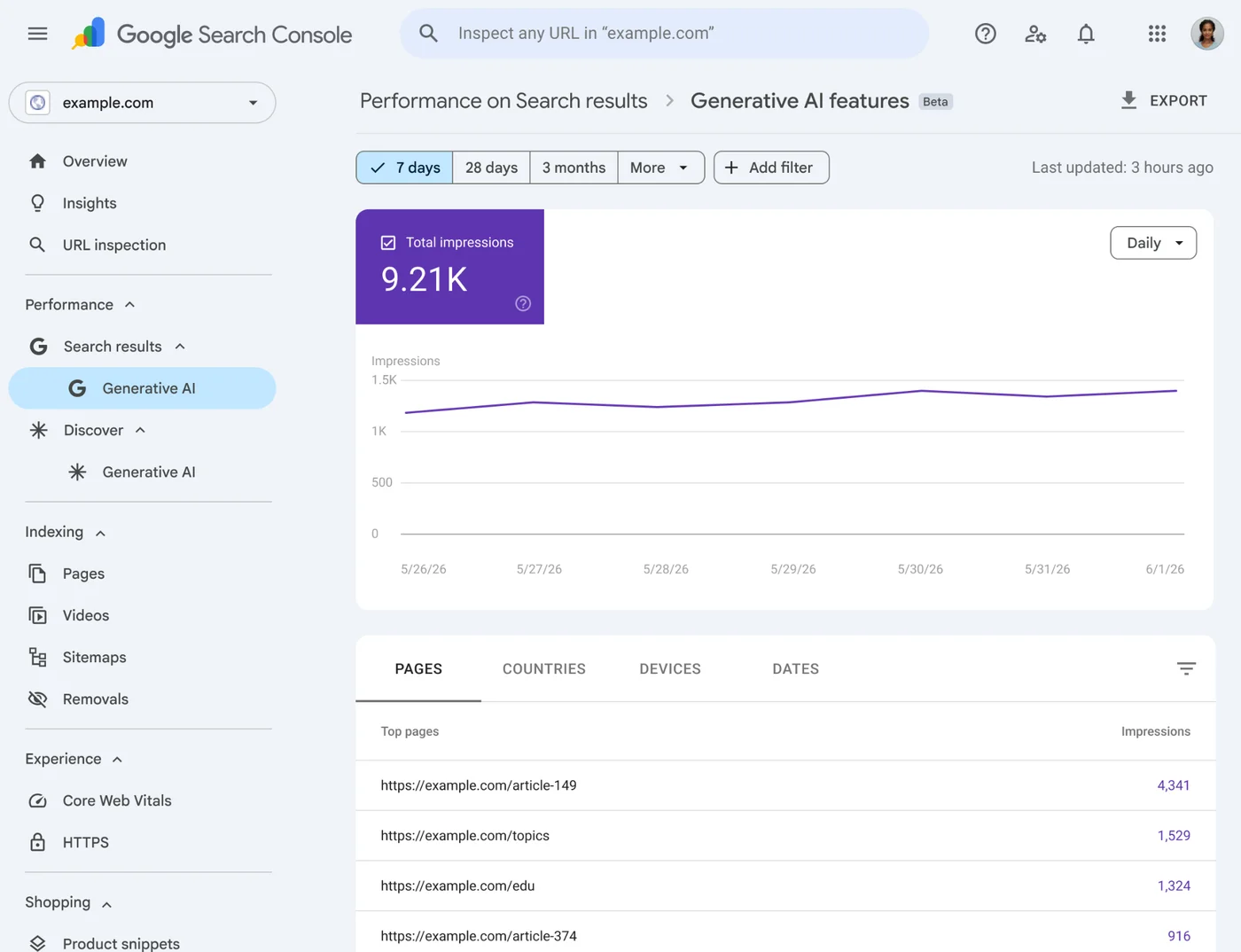
What do these two tools bring to GEO?
Google Search Console remains the official source for your site’s impressions and clicks in Google Search, and in AI Overviews and AI Mode with its new dedicated feature. Merchant Center is the channel through which your products, prices and availability feed Google’s shopping results, including in AI Mode and Gemini.
What they bring an ecommerce brand
The real queries, often long and conversational, for which your pages have appeared since AI Mode arrived: a valuable signal for writing buying guides that answer those questions.
An up-to-date product feed in Merchant Center, which Google needs to show the right price and availability in its AI answers.
Eligibility for native checkout in AI Mode and Gemini through the Universal Commerce Protocol goes through Merchant Center, currently for US merchants, and worth preparing for Europe.
Limitations
No data on ChatGPT, Perplexity, Claude or Copilot.
Search Console does not yet clearly separate impressions from AI answers and classic impressions.
Native checkout is not available in Europe as of October 2026.
Pricing and availability
Free, available worldwide.
Lengow: best for getting your catalog into ChatGPT
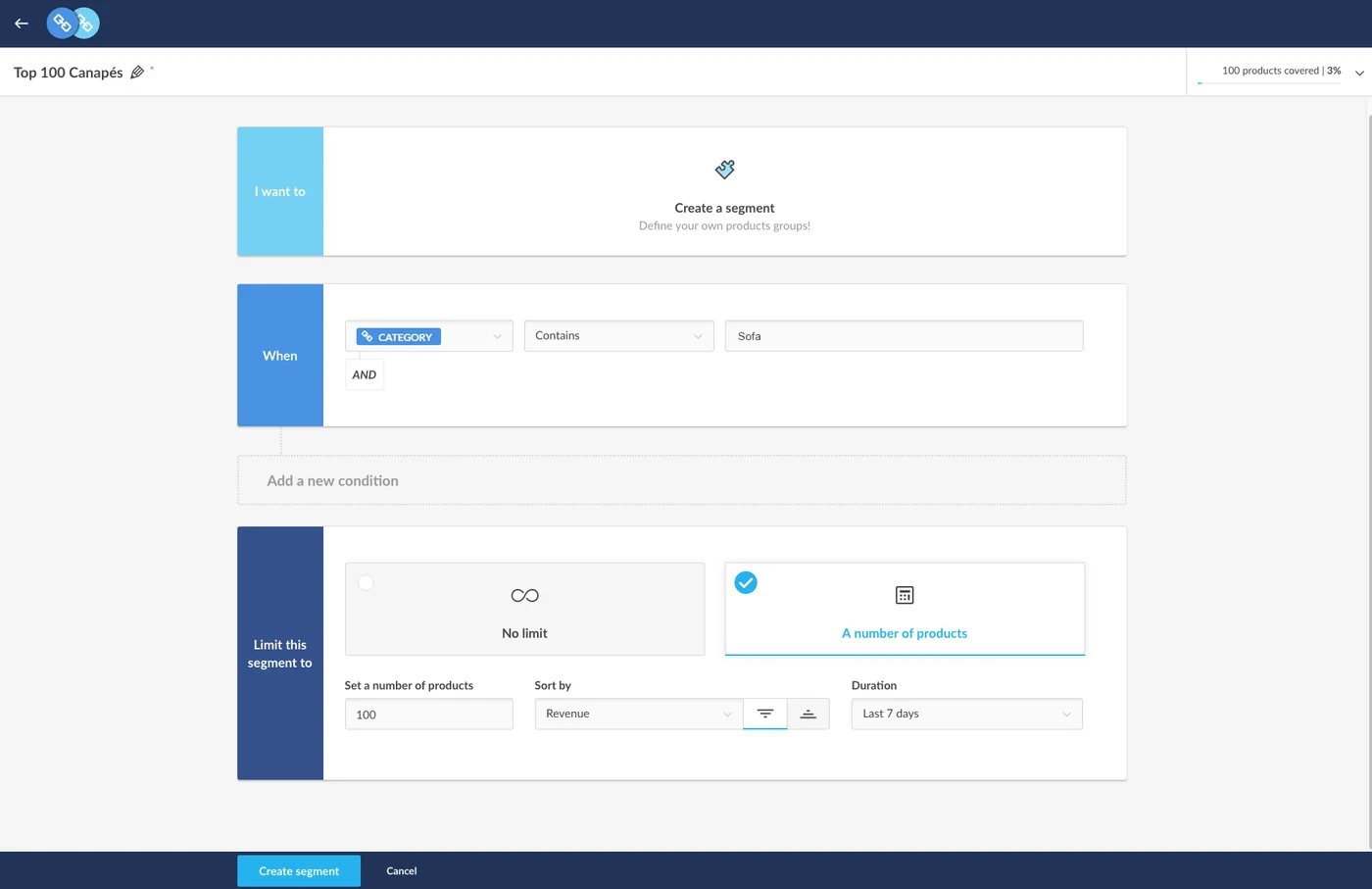
What is Lengow?
Lengow is a French product feed manager that distributes a catalog to marketplaces, comparison sites and advertising channels. Since October 2025, it has supported the ChatGPT feed that follows OpenAI’s Product Feed specification, which lets products appear in ChatGPT’s shopping results. Shoppingfeed, another French player, offers an equivalent channel to the ChatGPT Merchant portal.
What it brings an ecommerce brand
A feed that complies with OpenAI’s specification: title, description, link, image, price with currency, availability, stock, brand, condition, return and privacy policies.
Encrypted delivery to OpenAI’s endpoint, with updates possible every 15 minutes, so prices and stock are accurate in the answers.
A discovery mode: products can appear organically in conversations, with a link to your store, without buying ads.
The same feed logic serves Google Merchant Center and marketplaces, so you avoid maintaining several catalogs.
Limitations
A feed manager measures nothing: it sends the catalog, it does not tell you whether your products are recommended. It works alongside a measurement tool.
Registering on the ChatGPT Merchant portal and getting OpenAI’s approval are still required; in-chat payment is not offered in Europe.
Pricing and availability
On quote, French company, interface available in several languages.
Detailed comparison table
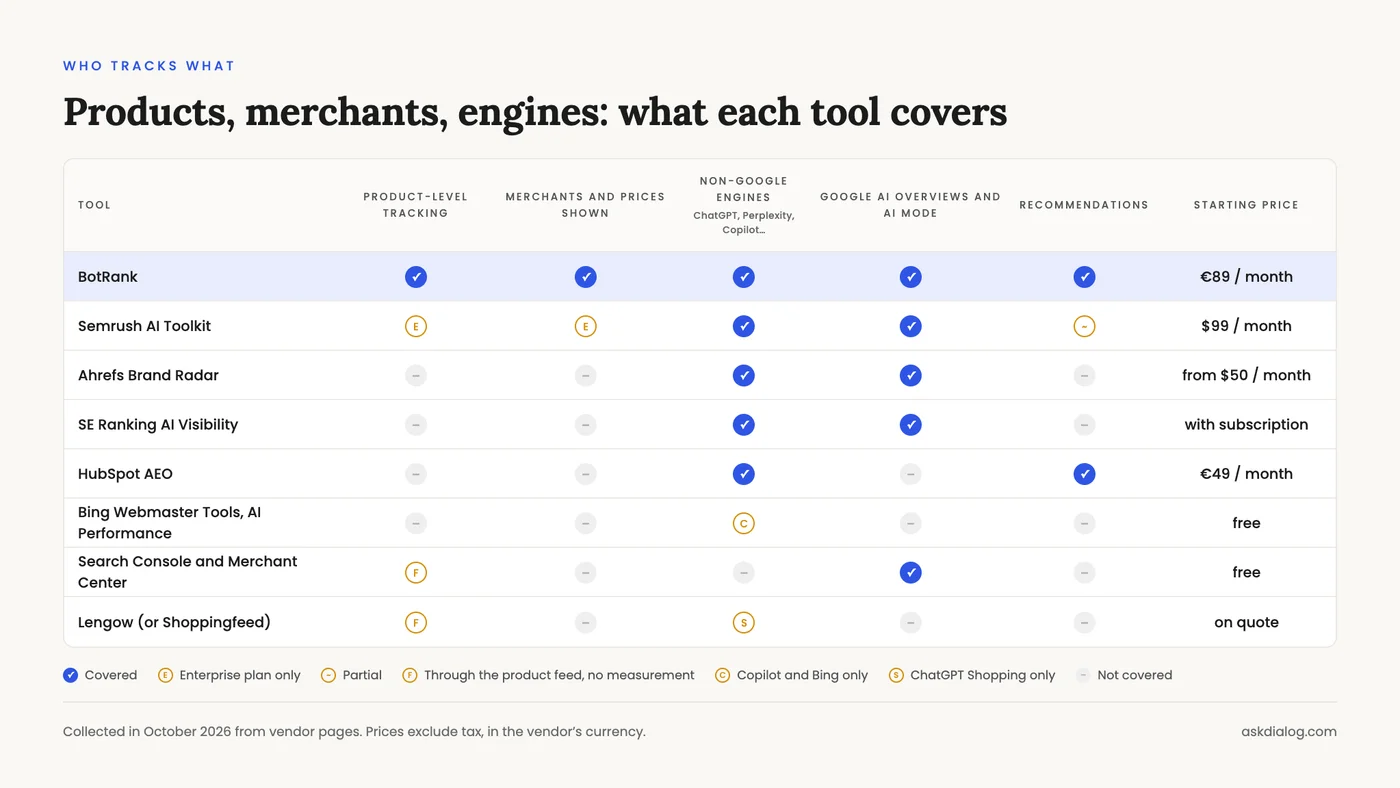
Feature coverage
Tool | Family | Product-level tracking | Merchants and prices displayed | Action recommendations | Multi-market |
|---|---|---|---|---|---|
BotRank | GEO specialist | Yes | Yes | Yes | All countries and languages |
Semrush AI Toolkit | SEO suite | Enterprise | Enterprise | Partial | Yes |
Ahrefs Brand Radar | SEO suite | No | No | No | Yes |
SE Ranking AI Visibility | SEO suite | No | No | No | Yes |
HubSpot AEO | CRM and marketing | No | No | Yes | Not specified |
Bing Webmaster Tools, AI Performance | Official source | No | No | No | Per site |
Search Console and Merchant Center | Official source | Product feed | No | No | Per country |
Lengow (or Shoppingfeed) | Feed management | Product feed | No | No | Yes |
Engines, pricing and compatibility
Tool | AI engines tracked | Free trial | Starting price | Ecommerce platforms |
|---|---|---|---|---|
BotRank | ChatGPT, Gemini, Google AI Overviews and AI Mode, Copilot, Perplexity, Claude, Mistral, Grok | 7 days | €89 per month | Platform-agnostic |
Semrush AI Toolkit | Major AI engines | Depends on plan | $99 per month | Platform-agnostic |
Ahrefs Brand Radar | Google AI Overviews and AI Mode, ChatGPT, Perplexity, Gemini, Copilot | Quota included in paid plans | $199 per month (index) | Platform-agnostic |
SE Ranking AI Visibility | ChatGPT, Perplexity, Gemini, Google AI Mode and AI Overviews | Yes, no card | With a subscription | Platform-agnostic |
HubSpot AEO | ChatGPT, Perplexity, Gemini | 28 days | €49 per month | Platform-agnostic |
Bing Webmaster Tools, AI Performance | Copilot and Bing | Free | Free | Platform-agnostic |
Search Console and Merchant Center | Free | Free | Shopify, WooCommerce, PrestaShop and others via feed | |
Lengow (or Shoppingfeed) | ChatGPT Shopping | Demo | On quote | Shopify, WooCommerce, PrestaShop, Magento and others |
Prices collected in October 2026, excluding tax, in the vendor’s currency.
Which GEO tool to choose for your profile?
Shopify store with under $1 million in revenue
Start with the free tools: HubSpot’s AI Search Grader to find out whether your brand exists in AI answers, Search Console and Merchant Center for Google, Bing Webmaster Tools for Copilot. As soon as you want to know which products are recommended and by whom, move to BotRank Starter, whose €89 per month plan covers every market and allows unlimited users. Check in Shopify Admin, under Sales channels then Agentic, whether your store is eligible for Agentic Storefronts.
Growing D2C brand
You sell mostly direct and have a catalog of a few hundred SKUs. The useful trio is BotRank for product-level measurement, Lengow or Shoppingfeed to send a clean feed to ChatGPT and Google, and a shopping agent on your site to convert visitors who arrive with an AI recommendation. If your team already uses Semrush or Ahrefs, keep them for SEO and add their AI module for a brand view, but do not count on them for product tracking.
Brand sold through retailers and marketplaces
Your challenge is not only being recommended, it is knowing who captures the sale. BotRank’s merchants and prices view answers that question directly: share of offers per seller, prices displayed by the AI, inconsistencies between your prices and your resellers’. Add Search Console for conversational queries and Bing Webmaster Tools to check that your own pages are cited, not just the marketplaces’.
Multi-country retailer
You need tracking per market and per language. BotRank covers every country and language from the Starter plan, and the Custom plan adds every engine, the API and MCP to feed your dashboards. Keep your existing SEO suite for classic search, one Merchant Center per country and a feed manager that handles local currencies and availability.
30, 60 and 90-day action plan
The first 30 days: measure
Turn on the AI Performance report in Bing Webmaster Tools and verify your Search Console property.
Run HubSpot’s AI Search Grader for a first baseline.
Start a BotRank trial, create 25 real shopping prompts your customers use (“best [product] for [use]”, “[your brand] or [competitor]”) and record presence, rank and merchants for your 10 most important products.
Check in your robots.txt that AI crawlers (GPTBot, ClaudeBot, PerplexityBot, Google-Extended, OAI-SearchBot) are not blocked by default.
Days 30 to 60: structure your product data
Update your Merchant Center feeds: explicit titles, complete attributes, synchronized prices and availability.
Add or complete Product and Offer structured data on every product page, with price, currency, availability and reviews.
Create the ChatGPT feed through your feed manager and register on the ChatGPT Merchant portal.
Fix the price gaps you spotted between your pages and what the AI engines display.
Days 60 to 90: get recommended and convert
Publish buying guides and comparisons that answer the prompts where your products are missing, citing your products with their precise attributes.
Work on customer reviews on the platforms AI engines cite in your category, identified through your GEO tool’s source analysis.
Deploy an AI shopping agent on your site to welcome visitors who come from an AI recommendation with your product data and your brand voice.
Measure again at 90 days and compare presence, rank and merchant share product by product.
Conclusion
In 2026, an ecommerce business does not need ten GEO tools, it needs three building blocks: a measurement tool that tracks products and not just the brand, the free reports from Google and Microsoft, and a clean product feed to ChatGPT and Google. BotRank is the only tool in this selection that fills the first role at product level, with merchants and prices; SEO suites add a useful brand view if you already own them; Lengow or Shoppingfeed handle distribution. The rest is conversion on your site, which AI engines will not do for you.