


Article overview
The native Shopify shopping assistant (Shopify Inbox’s AI agent) is free and a sensible first test to learn what shoppers ask, but we found no brand using it as their shopping assistant.
Dialog is the pick for brands with 25,000+ monthly visitors and products that need explaining before people buy (skincare, luggage, technical gear). It sits on the product page next to the add-to-cart button, bills a flat fee per traffic tier, and OhMyCream, Delsey and Jolly Mama run it live.
Rep AI is the pick for US direct-to-consumer brands that want an assistant to start the conversation. It has the largest review base of the dedicated assistants (4.6 from 117 Shopify reviews) and the strongest US reference list.
Gorgias is the pick if you already run your support on it. Its Shopping Assistant is an add-on to the helpdesk, and at our reference store it costs about four times Dialog.
Introduction
The biggest retailers no longer wait for shoppers to find the right product on their own.
Amazon now runs Alexa for Shopping, an assistant that answers questions, compares products and tracks price history. Walmart has Sparky, its own AI shopping assistant. Both companies built theirs in-house, with engineering teams most brands will never have.
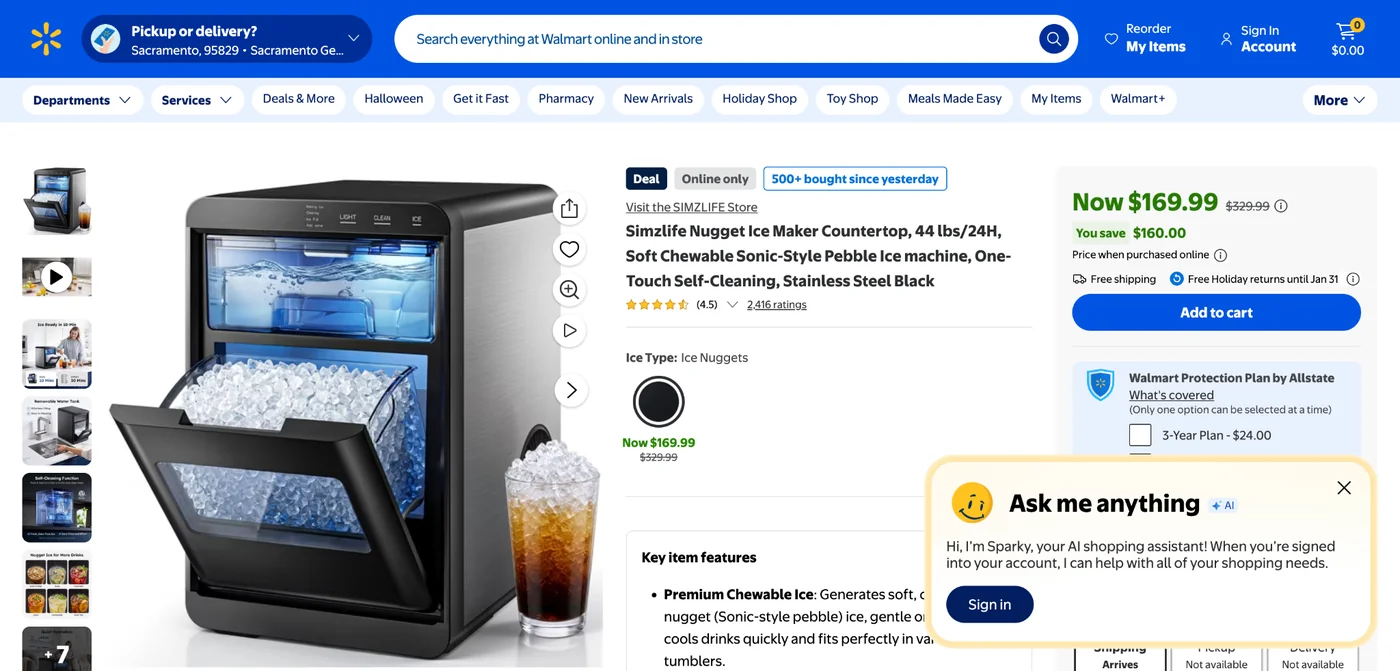
So what about Shopify stores? The best AI shopping assistant for Shopify should give an independent brand the same thing: a salesperson that knows the catalog, answers the question a product page left open, and helps the shopper decide. The Shopify App Store has dozens of apps claiming to do it.
This market moves every quarter, so feature lists go stale fast. Our view is that two things tell you more than any demo: which brands run the assistant live today, and what merchants say about it in recent Shopify reviews. That’s how we built this comparison.
Below you’ll find a clear definition of the category, five options compared on references, reviews and real pricing, a method for choosing, and the habits that make an assistant pay for itself after launch.
What is an AI shopping assistant?
An AI shopping assistant is software that talks to shoppers on your storefront before they buy. It reads your catalog, answers product questions in natural language, recommends the right item, and moves the shopper toward checkout. Think of the knowledgeable person on the shop floor who asks what you need before pointing at a shelf.
Four traits separate it from the tools it gets lumped in with:
It faces the shopper. Shopify Sidekick is an AI assistant too, but it serves the merchant inside the admin: it writes product descriptions, builds reports and creates discounts. It never speaks to a customer.
It works before the purchase. Helpdesk agents like Yuma or Siena are built for “where’s my order?” and returns. Some now add a sales mode, and we cover the best example (Gorgias) below, but their centre of gravity is post-purchase.
It understands the catalog. A live chat tool like Tidio routes conversations to a human and answers FAQs from your help centre. A shopping assistant has to know that the 30-litre bag fits under a plane seat and the 40-litre one doesn’t.
It adapts. A product quiz like Octane AI follows a fixed decision tree and stops at the recommendation. An assistant changes its questions based on the answers and keeps talking once the recommendation is made.
That definition leaves out some popular names, and deliberately. Tidio and Octane AI solve a different problem (live chat and quizzes), so we’ve left them out.
One more thing is changing the category: the assistant no longer has to live on your site. Shopify is pushing catalogs into ChatGPT and other AI tools, and some vendors now deploy a brand’s own agent there too. The work underneath is the same in both places: teaching an AI your catalog and how you sell. Brands that do it well on their own storefront today are doing the hard part early.
The 5 best AI shopping assistants for Shopify, compared
Applied to the Shopify App Store, that definition leaves five options worth comparing: Shopify’s own free agent as the baseline, three dedicated assistants, and the helpdesk most Shopify brands already know.
Important note: Each tool’s pricing section works out what it costs for the same reference store: a Shopify brand with 50,000 monthly visitors, about 1,000 support tickets a month, and about 1,000 shopper conversations with the assistant.
Platform | Best for | Shopify rating | G2 rating | Starting price |
|---|---|---|---|---|
Shopify Inbox (AI agent) | Answering basic questions at zero cost | 4.6 (5,803 reviews) | Not listed | Free, built into Shopify. Opt-in, self-serve. |
Dialog | High-consideration catalogs, 25k+ visitors | 5.0 (38 reviews) | 5/5 (10) | Free plan (200 conversations/mo); paid from $249/mo (25k visitors). 14-day trial, self-serve. |
Rep AI | Proactive selling for US DTC brands | 4.6 (117 reviews) | 4.9/5 (62) | From $12/mo (3,000 sessions). Free trial. |
Manifest AI | Testing an assistant on a small budget | 4.6 (60 reviews) | 4.5/5 (6) | Free plan; paid pricing not public. Demo required for paid plans. |
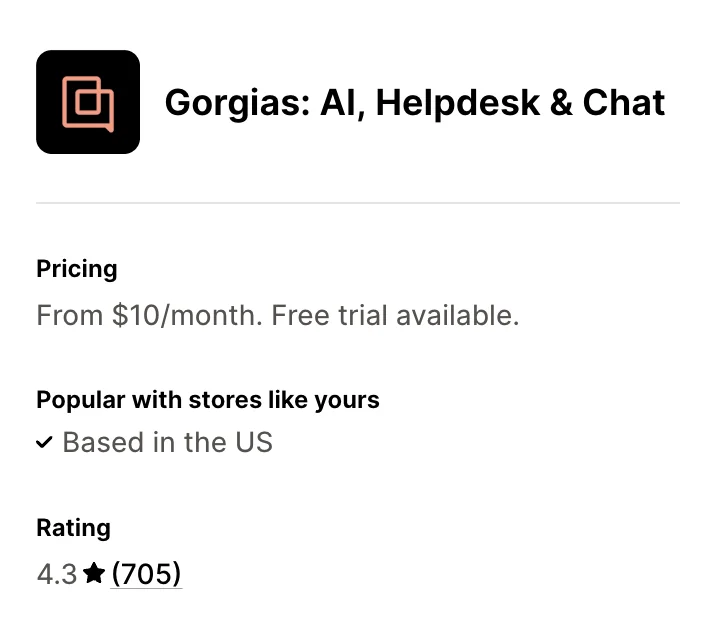
Gorgias | Brands already running Gorgias for support | 4.3 (705 reviews) | 4.6/5 (562) | From $40/mo (50 tickets, 30 AI interactions); helpdesk required. 7-day trial, self-serve. |
Shopify Inbox AI agent
Shopify Inbox verdict
Shopify Inbox’s AI agent is free and already in your admin, which makes it the obvious baseline and a weak final answer.
It answers questions about products, shipping, returns and sizing from the content you’ve already published, inside the same chat bubble shoppers associate with support. But we’ve spent 30 minutes trying to find a store using it as their shopping assistant and we didn’t find any. For a tool that costs nothing to switch on, that silence tells you something.
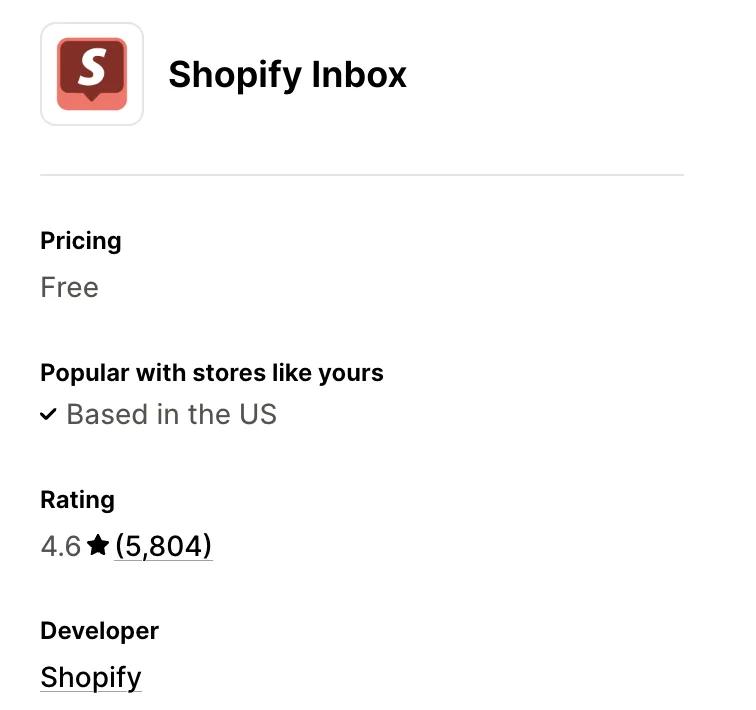
The 4.6 rating from 5,803 reviews looks reassuring, but it rates Inbox as a whole, the messaging app merchants have used for years. Very few of those reviews describe the AI agent, which is opt-in and recent.
Who Shopify Inbox works best for
Small stores with simple catalogs and a few hundred visitors a day. If most of your questions are “do you ship to Canada?” and “what’s your return window?”, the Inbox agent will handle them and you’ll save the subscription. It’s also a sensible first test: switch it on for a month, read the transcripts, and you’ll learn what your shoppers actually ask.
Shopify Inbox top features
Opt-in AI agent that answers questions about products, shipping, returns, sizing and store policies
Trained on your product catalog, store policies, Knowledge Base facts and files, and published storefront content (pages, blog posts, care guides)
Personalised recommendations based on preferences, sizes and purchase history, when the shopper is signed in with Shop
Cited web search results for qualitative reviews of a product
Staff can take over from the Inbox desktop, iOS or Android app
Configurable persona and training from the Shopify admin
Shopify Inbox integrations
Inbox is native to Shopify, so the catalog, orders and customer accounts are connected from day one. It also draws on Shop app sign-ins for personalisation. Outside the Shopify ecosystem, it connects to very little.
Shopify Inbox pricing
Free, included with every Shopify plan.
At the reference store (50,000 visitors, 1,000 assistant conversations a month) the bill is still $0.
Shopify Inbox pros
No subscription and no usage fees, at any volume
Nothing to install; it lives in the Shopify admin you already use
Native access to catalog, orders and Shop customer data
A low-risk way to discover what shoppers ask before buying anything else
Shopify Inbox cons
No public references: we found no brand presenting it as their shopping assistant
Lives in the chat bubble, a corner of the page shoppers open when something has gone wrong
Learns only from published content, so gaps in your product pages become gaps in its answers
Generic by design: the same agent, tuned the same way, for millions of stores
Shopify Inbox video
Dialog
Dialog verdict
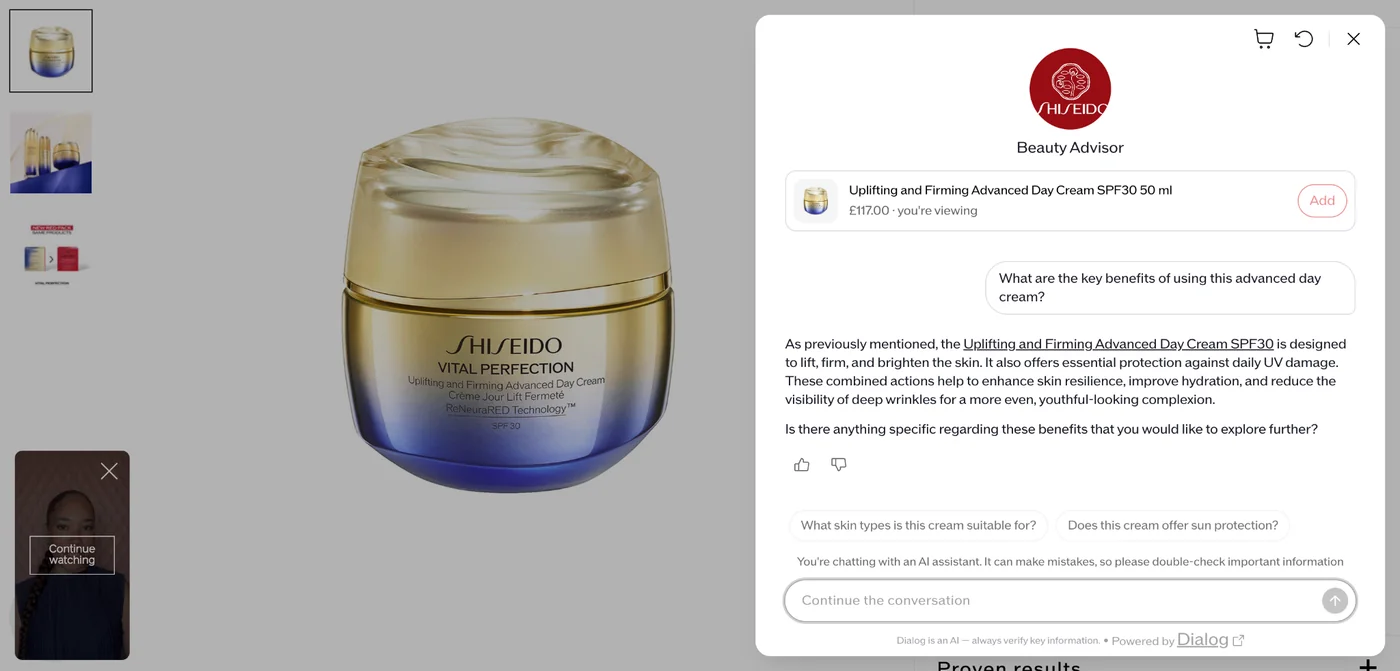
Dialog is the strongest choice for Shopify brands whose products need explaining: skincare, luggage, supplements, technical gear, anything where a shopper hesitates because they aren’t sure it’s right for them.
It places the assistant on the product page, just below the add-to-cart button, where the buying decision actually happens. Pricing is a flat fee per traffic tier, so you know the bill before you sign. The honest caveat is a smaller review base than the incumbents, which we come back to below.
Who Dialog works best for
Mid-market and enterprise brands with 25,000+ monthly visitors on Shopify, and catalogs where expertise sells. A shopper asking “can I use this serum while pregnant?” or “will this suitcase fit Ryanair’s cabin limit?” needs an answer before they’ll add to cart.
Brands like OhMyCream, Delsey and Jolly Mama run Dialog for exactly that reason. Below 25,000 visitors, the free plan or Shopify Inbox is a better starting point.
Dialog top features
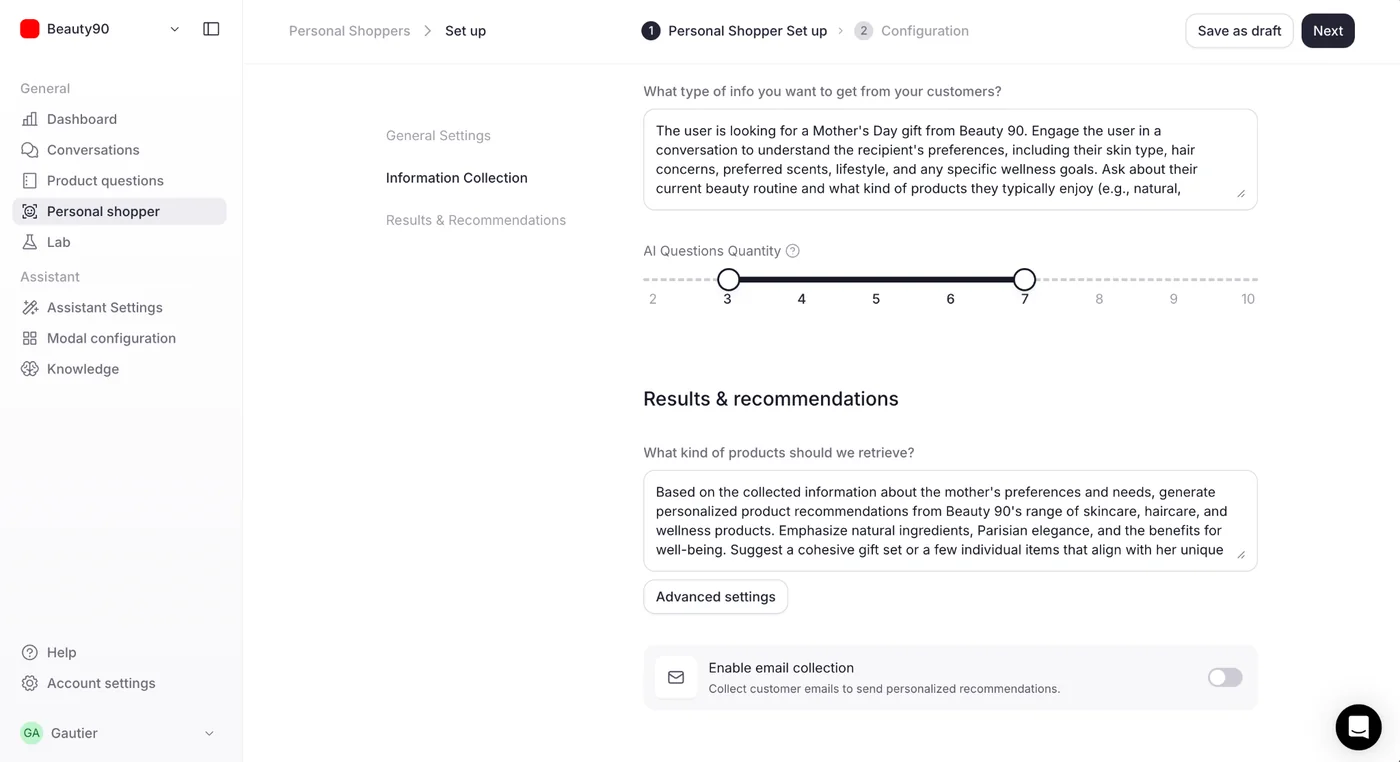
Personal Shopper: works like a sales associate across the whole catalog. It asks what the shopper needs, narrows the options and recommends a product; shoppers can even upload a photo of what they’re looking for.
AI PDP Assistant: answers product questions right below the add-to-cart button. Each product page opens with a few ready-made questions written from that product’s details, so shoppers have a reason to ask before they leave.
Smart Reengagement: follows up with shoppers who left without buying, using what they asked about to make the message relevant.
Analytics and ROI: built-in A/B testing shows the extra conversions the assistant drives, with the results also visible in GA4. A report of the questions it couldn’t answer tells you which product pages need more detail.
ChatGPT Apps: puts the same assistant inside ChatGPT, so shoppers who start their research there get your brand’s answers and product knowledge.
Dialog integrations
Dialog runs on Shopify, Salesforce Commerce Cloud, BigCommerce, SAP, Scayle and Spryker. It ingests the catalog, internal documents and published content such as blog articles, and reports conversion into GA4.
Dialog pricing
Dialog bills on monthly unique visitors, not on conversations:
Free: $0 for 200 conversations a month
Starter: $249/mo, up to 25,000 unique visitors
Standard: $399/mo, up to 50,000 unique visitors
Scale: $799/mo, up to 100,000 unique visitors
All paid plans include a 14-day free trial and are billed in USD every 30 days.
At the reference store, 50,000 monthly visitors fit the Standard plan: $399 a month, whether shoppers have 500 conversations or 5,000. The more shoppers use it, the cheaper each conversation gets, which is the incentive you want.
Dialog pros
Sits on the product page, at the point of decision, so shoppers see it without opening a chat
Flat pricing per traffic tier, known before you sign
Learns from your catalog, internal docs and published content
Shows the questions your product pages fail to answer, so you can fix the pages too
Native A/B testing with the conversion delta reported in GA4
30-minute onboarding on Shopify, no Core Web Vitals impact, deactivation in two minutes (per merchant reviews)
Dialog cons
Smaller review base (38 Shopify reviews) than Gorgias or Rep AI
A standalone assistant, so support tickets still need a helpdesk
Built for 25,000+ visitors; smaller stores pay for capacity they won’t use
Newer than the legacy players in the category
Dialog video
A quick note: Dialog is our product, so weigh our enthusiasm accordingly. The pricing, ratings and references in this article come from public App Store listings, vendor pricing pages and our own competitor research. Our Shopify review count (38) is lower than Gorgias’s or Rep AI’s, partly because pre-purchase assistants are a young category, and we’d rather you see that here than discover it on the App Store.
Rep AI
Rep AI verdict
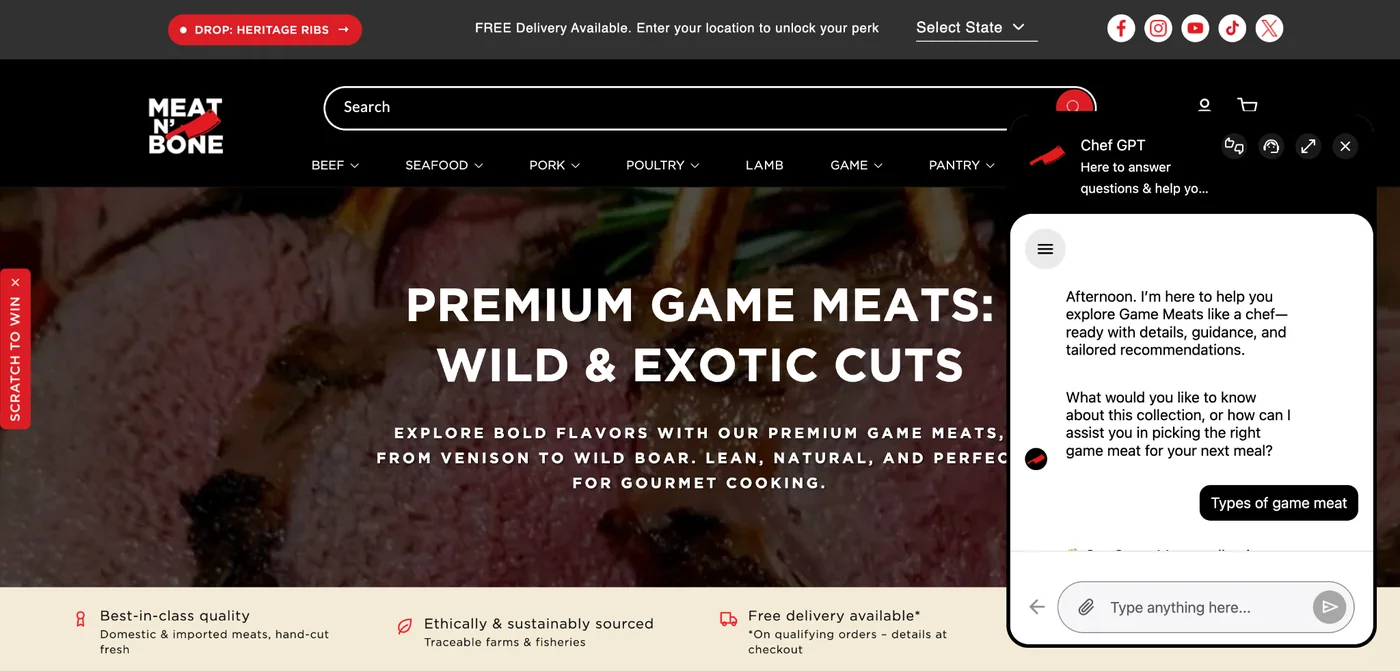
Rep AI is the best choice for US direct-to-consumer brands that want an assistant to start the conversation instead of waiting for a click. It watches shopper behaviour (repeat visits, product comparisons, exit signals) and opens a chat when it detects hesitation. It has the strongest reference list among dedicated assistants and the Built for Shopify badge. Watch the pricing: it bills on sessions, so a big sale month can move you up a tier.
Who Rep AI works best for
US-based Shopify brands in fashion, supplements, outdoor and food, with enough traffic to justify a proactive approach. Rep AI is used on around 1,055 stores, including AMIRI, 7 For All Mankind, OLLY, Goal Zero and Harney & Sons. If your shoppers browse a lot before deciding and you’re comfortable with an assistant that interrupts them, Rep AI fits.
Rep AI top features
Proactive “AI Sales Concierge” that triggers conversations on behavioural signals such as confusion or exit intent
Product discovery, recommendations, upsells and FAQ answers in the chat widget
An optional AI support agent that resolves routine issues and can cancel orders and process returns in Shopify
One AI across on-site chat, email, Instagram and Facebook DMs, and WhatsApp
Multi-language support, with customisable design and tone
Rep AI integrations
Shopify, Salesforce Commerce Cloud and WooCommerce. For human handoff, Rep AI connects to Gorgias, Zendesk and Help Scout. It also integrates with Klaviyo and Tapcart.
Rep AI pricing
Rep AI bills on monthly sessions, with separate prices for the sales agent and the support agent:
3,000 sessions: $12/mo (sales agent)
10,000 sessions: $104/mo
25,000 sessions: $209/mo
50,000 sessions: $368/mo
80,000 sessions: $578/mo
180,000 sessions: $1,040/mo
Annual billing cuts about 20% off the sales agent (for example $462/mo instead of $578 at 80,000 sessions). Adding the support agent costs extra: $726/mo for both at 80,000 sessions.
At the reference store, 50,000 visitors generate more than 50,000 sessions (about 70,000 at a typical 1.4 sessions per visitor). That lands in the 80,000-session tier: $578 a month for the sales agent, $726 with support. A Black Friday month that pushes sessions past 80,000 moves you to the $1,040 tier.
Rep AI pros
Proactive engagement reaches shoppers who would never open a chat themselves
Strong, recognisable US references (AMIRI, 7 For All Mankind, OLLY)
Largest review base among dedicated assistants: 4.6 from 117 Shopify reviews, 4.9 from 62 on G2
“Built for Shopify” badge
Responsive support and dedicated account managers, the most praised point on G2 (28 mentions)
Rep AI cons
Session-based pricing jumps a tier during traffic peaks
AI answers need fine-tuning and are occasionally wrong (7 G2 mentions)
The back end is technical and building flows is manual (5 G2 mentions)
Recommendations are based on the conversation rather than deep catalog intelligence
Rep AI video
Manifest AI
Manifest AI verdict
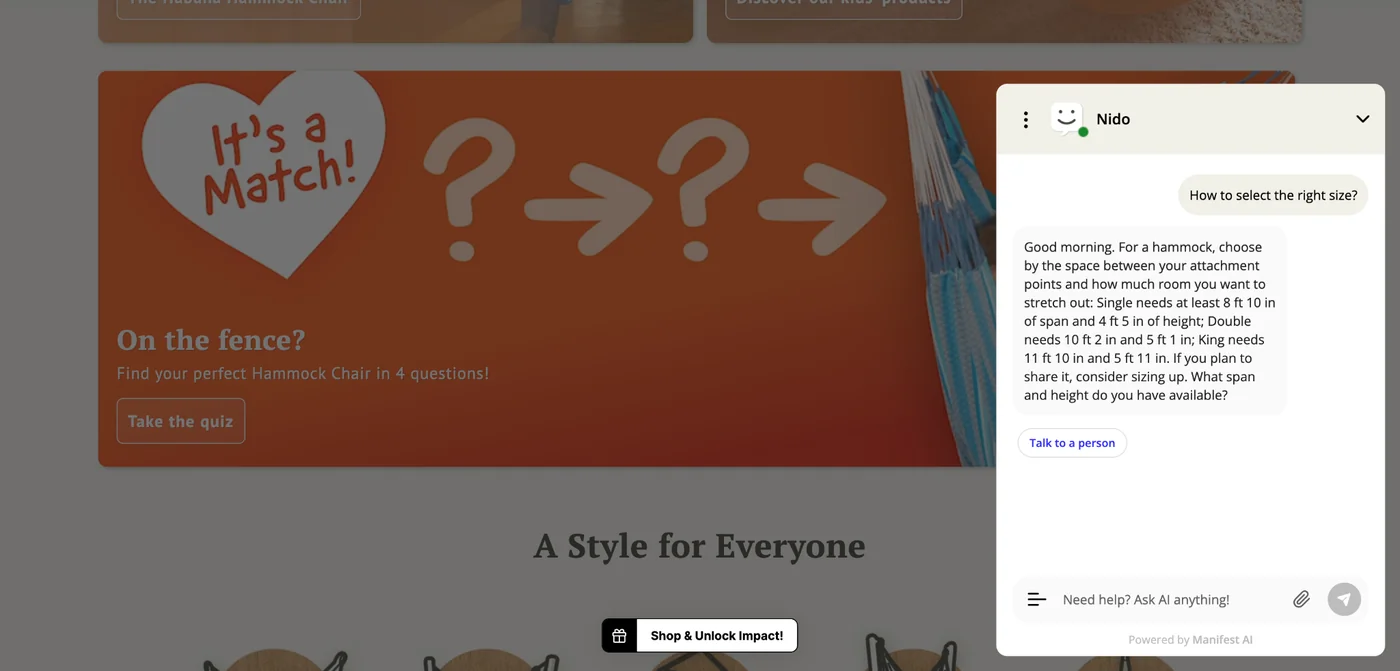
Manifest AI is a reasonable low-cost way to test whether your shoppers want to talk to an AI. It has a free plan, the “Built for Shopify” badge and a 4.6 rating. Beyond that, the evidence thins out: paid pricing isn’t public, the install base is small, and its feature list is so broad (100+ pre-built agents) that it’s hard to tell what it does best. Start on the free plan and judge it on your own transcripts.
Who Manifest AI works best for
Smaller Shopify stores that want to experiment with an AI chatbot, quiz and product recommendations in one app before committing a budget. Its website lists Transformer Table, LEGO, Mitchell Brands, Imagine and Durex among its customers, and recent App Store reviewers include Fitness Outlet, LA SIESTA and McClure’s. Its strongest market is India; the US comes second.
Manifest AI top features
Pre-purchase agents: catalog-based recommendations, a size and fit agent, a product trivia agent, quiz-based discovery and search
Post-purchase agents: order status, returns, shipping and policy questions
Upsell and cross-sell on the cart, checkout, product page and thank-you page, plus cart recovery and pop-ups
Widgets that can sit on product pages and quiz embeds, as well as the chat bubble
A/B testing of placements, conversion and recommendation analytics
Three model tiers (Lite, Pro, Ultra), custom instructions and guardrails
Manifest AI integrations
Shopify, WooCommerce and BigCommerce. It also deploys on email, Instagram, WhatsApp and voice.
Manifest AI pricing
The free plan includes the AI chatbot, product recommendations, AI training, cart and checkout recovery and lead collection. Paid pricing isn’t public.
For the reference store, that means we can’t give you a number…
Manifest AI pros
Free plan with the core chatbot and recommendations
“Built for Shopify” badge and a 4.6 rating from 60 reviews
Broad feature set: quiz, size and fit, upsells and support in one app
Can place widgets on product pages, not only in the chat bubble
SOC 2 and ISO 27001 certified
Manifest AI cons
Paid pricing isn’t public
Small installed base
Only 6 reviews on G2, too few to read a pattern
Customer base concentrated in India, with fewer US and European references
Manifest AI video
Gorgias
Gorgias verdict
If your support team already lives in Gorgias, its Shopping Assistant is the path of least resistance. It’s the leading Shopify helpdesk, with 25,000+ stores and deep order data, and since 2025 it also engages shoppers before they buy. Buy it as a helpdesk that also sells, rather than as a shopping assistant. You can’t buy the AI without a helpdesk plan, and every AI interaction beyond your allowance is billed, so the cost climbs with exactly the traffic you’re trying to convert.
Who Gorgias works best for
Shopify brands with real support volume (hundreds or thousands of tickets a month) that want sales and support in one inbox. Steve Madden, Princess Polly, Fashion Nova, Reebok and Timex all run Gorgias. If you don’t need a helpdesk, it’s an expensive way to get a shopping assistant.
Gorgias top features
One inbox for email, chat, SMS, social and voice, with Shopify order context in every ticket
AI Agent that resolves common requests (order tracking, address changes, cancellations, refunds) on its own
Shopping Assistant that answers product questions, recommends items and offers discounts when it detects hesitation
“Skills”, “Guidance” and tone-of-voice settings to shape how the AI behaves
Revenue tracking that ties support conversations to sales
Gorgias integrations
Shopify, WooCommerce, BigCommerce, Magento and PrestaShop, plus a large app ecosystem across reviews, returns, subscriptions and marketing. The Shopify integration is the one reviewers praise most: refunds, cancellations and order edits happen without leaving the ticket (again this is not what an AI shopping assistant is built for, but it’s a big part of what Gorgias offers).
Gorgias pricing
Gorgias bills on tickets, with a set number of AI interactions included in each plan:
Starter: $40/mo, 50 tickets and 30 AI interactions
Basic: $90/mo, 300 tickets and 30 AI interactions
Pro: $550/mo, 2,000 tickets and 190 AI interactions
Advanced: $1,430/mo, 5,000 tickets and 530 AI interactions
Each AI interaction beyond the allowance costs $1.50. You can’t buy the AI on its own.
At the reference store, 1,000 tickets a month rules out Basic, so you’re on Pro at $550. The 1,000 shopper conversations use the 190 included AI interactions, leaving 810 billed at $1.50, or $1,215. Total: about $1,765 a month, roughly four times Dialog for the same store. And because the bill tracks conversations, your most successful month is also your most expensive one.
Gorgias pros
The default Shopify helpdesk, with 705 Shopify reviews
Deep Shopify integration: refunds, cancellations and order edits from the ticket
AI Agent deflects a large share of tickets (the most common praise in Shopify reviews, 109 mentions)
Sales and support in one inbox, with revenue attribution
“Built for Shopify” badge and a 7-day free trial
Gorgias cons
The Shopping Assistant requires a full helpdesk subscription
Overage pricing escalates fast: 20 Shopify reviews complain about it, one citing “$14.50 per inquiry”
AI quality issues, from made-up answers to sudden drops in resolution rate (18 Shopify review mentions)
Its own support has slowed down, according to 37 Shopify reviews
Support-first design, with limited depth on product discovery
Gorgias video
How to choose the best AI shopping assistant for your Shopify store
Now, let’s take a look at how to make a final decision.
1. Start with live references
A logo on a homepage costs nothing. A brand running the assistant on its live store today costs the vendor a real customer.
Before any demo, pick three brands from the vendor’s reference list, visit their product pages, and use the assistant yourself. Ask it a question a real shopper would ask, including one the product page doesn’t answer.
If you can’t find a single live example, as it happened for us with Shopify Inbox’s AI agent, treat that as information.
2. Read Shopify reviews by count and by date
The Shopify App Store is the closest thing this category has to independent proof, because only merchants who installed the app can review it. Read three things:
The score, but never on its own. A 5.0 from 38 reviews and a 4.6 from 117 reviews tell different stories.
The count, as a proxy for how many brands have lived with the product.
The dates. Filter to the last six months. In a market this fast, a review from 2024 describes a different product.
Check what’s being rated, too. Gorgias’s 4.3 and Shopify Inbox’s 4.6 rate the helpdesk and the messaging app, not the AI shopping feature.
3. Price it against your own traffic
Write down three numbers: monthly visitors, monthly sessions and monthly support tickets. Then price every shortlisted tool against them, including your biggest month. At our reference store the spread runs from $0 to about $1,765 a month, and the ranking changes depending on whether a tool bills on visitors, sessions, tickets or conversations.
4. Check where it sits on the page
Shoppers open a chat bubble when something has gone wrong. An assistant placed on the product page, near the add-to-cart button, reaches them while they’re still deciding. Ask every vendor where the assistant can appear, and whether you can test placements against each other.
5. Insist on a holdout test
“AI-influenced revenue” counts every order where a shopper touched the widget, including people who were going to buy anyway. The only credible measure is incremental conversion: show the assistant to some visitors and not others, then compare. If a vendor can’t run that test, run it yourself with your analytics tool before you renew.
How to get the most out of your AI shopping assistant
Choosing the tool is half the work. The brands that get results treat the assistant like a new member of the sales team: they train it, place it well and review its work.
Feed it your best sales knowledge. Product pages are written for search engines. Your best sales associates know the real objections. Upload sizing guides, ingredient explanations, comparison sheets and the answers your support team gives every week.
Put it where decisions happen. Start with your highest-traffic product pages and your most-returned products, where a better answer before purchase saves a return after it.
Write the suggested questions. Most shoppers won’t type the first message. Two or three suggested questions on each product page (“Is this suitable for sensitive skin?”, “Which size should I pick?”) give them a reason to start.
Read the unanswered questions every month. The questions your assistant can’t answer are a to-do list for your product pages. Fixing them improves the pages for everyone, including shoppers who never chat.
Check your product data. An assistant is only as good as the metafields, variants and descriptions it reads. Missing sizes or vague materials turn into vague answers.
Measure incrementally, then expand. Run a holdout test on one product category, prove the lift, then roll out. Re-test after big catalog or seasonal changes.
Watch page speed. Any script on the product page can slow it down. Check Core Web Vitals before and after launch.
Conclusion
The big retailers built their own shopping assistants.
Shopify brands can now buy one, and the choice comes down to proof and price more than features.
Switch on Shopify Inbox’s agent to learn what shoppers ask, then move on once you want an assistant that sells.
Choose Dialog if you have 25,000+ monthly visitors and products that need explaining. It sits on the product page, bills a flat $399/mo at 50,000 visitors, and runs live at OhMyCream, Delsey and Jolly Mama.
Choose Rep AI if you’re a US DTC brand that wants an assistant to start conversations. It has the deepest review base of the dedicated assistants; budget for tier jumps in peak months ($578/mo at our reference store).
Choose Gorgias if you already run your support on it and want sales in the same inbox. Expect about $1,765/mo at our reference store, rising with every extra conversation.
Try Manifest AI on its free plan if you want to test the idea on a small budget, knowing paid pricing isn’t public.
Whatever you pick, visit three live references, read the last six months of Shopify reviews, and measure against a holdout.